Day and night, and the seasons in New Zealand
What this lesson covers
- Earth spins on its axis once a day, so each place turns into sunlight (day) and out of it (night).
- Earth's axis is tilted 23.4° and keeps pointing the same way in space as Earth orbits the Sun once a year.
- When the Southern Hemisphere leans towards the Sun the Sun climbs higher and days are longer, so New Zealand gets more solar radiation: summer.
- Solstices and equinoxes, and how the Sun's path, sunrise point and shadows change through the year.
- How day length and Sun height differ between places at different latitudes, such as Auckland and Invercargill.
- Seasons are not caused by Earth's distance from the Sun.
Earth's spin makes day and night
- The Sun lights one half of Earth at a time. The half facing the Sun has day; the half facing away has night.
- Earth spins on its axis from west to east, carrying each place into the sunlit half and then out again: one turn relative to the Sun takes 24 hours.
- Because we are carried eastwards, the Sun seems to rise in the east, cross the sky and set in the west. The Sun is not moving round us; we are turning.
- From New Zealand the Sun is always in the northern part of the sky at midday, so midday shadows point south.
- Shadows are long in the morning and evening when the Sun is low, and shortest around midday when it is highest. Morning shadows point west (to the south-west), afternoon shadows point east (to the south-east).
A tilted axis that always points the same way
- Earth orbits the Sun once every 365.25 days, which is why a leap day is added every four years.
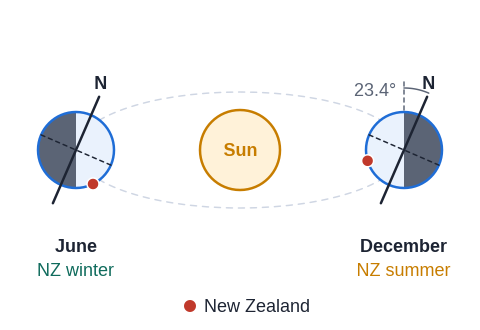
- Earth's axis is tilted 23.4° from upright compared with its orbit, and it keeps pointing in the same direction in space all the way round the orbit.
- So in December, on one side of the orbit, the Southern Hemisphere leans towards the Sun. Six months later, on the other side, the same tilt makes it lean away.
- Leaning towards the Sun gives New Zealand summer; leaning away gives winter. At the same moment the Northern Hemisphere has the opposite season, which is why Christmas is in summer here and in winter in London.
- In March and September neither hemisphere leans towards the Sun, and both get similar sunlight: autumn and spring.
Try it: the tilt and the seasons
Why a high Sun heats more
- Sunlight carries energy as solar radiation. What warms the ground is how much of that energy lands on each square metre.
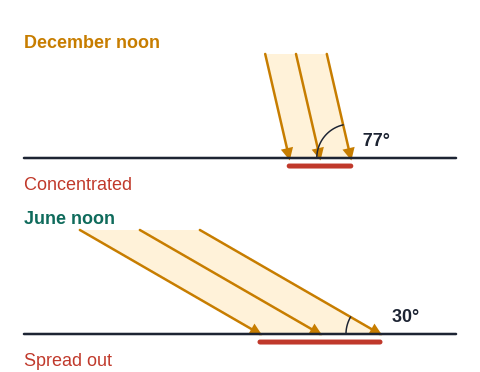
- When the Sun is high, a beam of sunlight hits the ground almost straight on and its energy is concentrated on a small area.
- When the Sun is low, the same beam hits at a slant and spreads over a much bigger area, so each square metre gets less energy. Low sunlight also passes through more air, which absorbs and scatters some of it.
- At midday in Auckland the Sun is about 77° high in late December but only about 30° high in late June; a beam at 30° covers about twice the ground it would cover at 77°.
- Write "more solar radiation per square metre", not "more sunlight": NZQA's markers noted that many answers lost the point by talking about light rather than radiation or heat.
Longer days in summer, shorter in winter
- The tilt also changes how long each place spends in the sunlit half. In December the Southern Hemisphere leans into the light, so more of each circle of latitude is in daylight and days are longer than nights.
- In June the Southern Hemisphere leans away, so more of each circle is in darkness and nights are longer.
- The further a place is from the Equator, the bigger this effect, so Invercargill has longer summer days and shorter winter days than Auckland.
- At the equinoxes neither hemisphere leans towards the Sun, so day and night are close to 12 hours everywhere (slightly over, because the air bends sunlight over the horizon).
- Summer is warm for two reasons that add together: the Sun is higher, so each square metre gets more radiation, and the days are longer, so it gets that radiation for more hours.
| City (latitude) | 21 June | 23 September | 22 December |
|---|---|---|---|
| Auckland (37°S) | 07:34 to 17:12, 9 h 38 min | 06:10 to 18:18, 12 h 8 min | 05:58 to 20:40, 14 h 42 min |
| Wellington (41°S) | 07:47 to 16:58, 9 h 11 min | 06:09 to 18:18, 12 h 9 min | 05:44 to 20:54, 15 h 10 min |
| Christchurch (44°S) | 08:03 to 16:59, 8 h 56 min | 06:18 to 18:27, 12 h 9 min | 05:45 to 21:11, 15 h 26 min |
| Invercargill (46°S) | 08:31 to 17:06, 8 h 35 min | 06:35 to 18:44, 12 h 9 min | 05:50 to 21:39, 15 h 49 min |
Try it: daylight hours through the year
Solstices, equinoxes and the Sun's path
- The summer solstice (about 22 December) is the day the Sun reaches its highest midday point in our sky: the longest day of the year in New Zealand.
- The winter solstice (about 21 June) is the day of the lowest midday Sun and the shortest day.
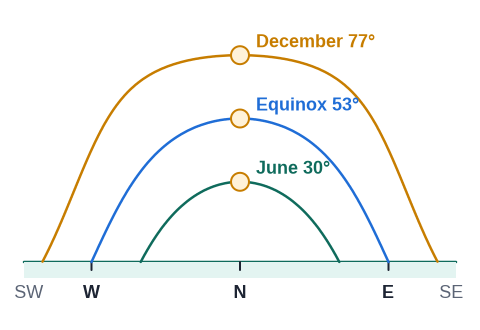
- At the two equinoxes (about 21 March and 23 September) the Sun is overhead at the Equator at midday, rises due east, sets due west, and day and night are nearly equal.
- In summer the Sun rises south of east and sets south of west, making a long high arc. In winter it rises north of east and sets north of west, making a short low arc.
- For a place at latitude L south, the midday Sun height is about 90° − L at an equinox, 90° − L + 23.4° at the summer solstice and 90° − L − 23.4° at the winter solstice.
| Event | Date |
|---|---|
| Perihelion (Earth closest to the Sun) | 4 January |
| Autumn equinox | 21 March |
| Winter solstice (shortest day) | 21 June |
| Aphelion (Earth furthest from the Sun) | 7 July |
| Spring equinox | 23 September |
| Summer solstice (longest day) | 22 December |
Sky and seasons
Example: midday Sun and shadows, Auckland and Invercargill
- Auckland is at 36.9°S and Invercargill at 46.4°S.
- Find the midday Sun height in each city at both solstices, and compare the midday shadow of a 1 m stick in June.
- Auckland, December: 90 − 36.9 + 23.4 = 76.5 ≈ 77°summer solstice: add the tilt
- Auckland, June: 90 − 36.9 − 23.4 = 29.7 ≈ 30°winter solstice: take the tilt away
- Invercargill, December: 90 − 46.4 + 23.4 = 67°further south, so lower
- Invercargill, June: 90 − 46.4 − 23.4 = 20.2 ≈ 20°very low winter Sun
- shadow = 1 ÷ tan 29.7° = 1.8 m in Auckland; 1 ÷ tan 20.2° = 2.7 m in Invercargilla lower Sun casts a longer shadow
- Invercargill's midday Sun is about 9.5° lower all year, so its radiation is more spread out and its shadows are longer
Try it: the midday Sun and its heat
Example: reading New Zealand temperatures
- The table shows NIWA's long-term average air temperatures for January and July.
- Use it to describe the seasons and explain why the south is colder.
| Place | January | July | Difference |
|---|---|---|---|
| Auckland | 20.0 | 11.2 | 8.8 |
| Wellington | 17.0 | 9.2 | 7.8 |
| Christchurch | 17.1 | 6.0 | 11.1 |
| Invercargill | 14.2 | 5.4 | 8.8 |
- every place is about 8 to 11 °C warmer in January than Julydescribe the pattern
- January: Southern Hemisphere tilted towards the Sun, high Sun, long daysmore solar radiation per square metre, for more hours
- Invercargill is coldest in both monthsat 46°S its Sun is always lower, so the same radiation is spread over more ground
- summer warmth comes from Sun height and day length, both caused by the tilt
- February is as warm as January (Auckland 20.5 °C)land and sea keep warming for weeks after the solstice, so the warmest month lags behind
It is not about distance from the Sun
- Earth's orbit is very nearly a circle. Its distance from the Sun changes by only about 3% over the year.
- Earth is closest to the Sun in early January, during our summer, but that same week is the middle of winter in the Northern Hemisphere. If distance caused the seasons, both hemispheres would have summer at once.
- The tilt explains the facts that distance cannot: opposite seasons in the two hemispheres, and longer summer days that grow longer the further you go from the Equator.
| Position | Distance from the Sun |
|---|---|
| Perihelion (closest, early January) | 147.1 million km |
| Aphelion (furthest, early July) | 152.1 million km |
How the seasons change from the Equator to Antarctica
- At the Equator the midday Sun is high all year and days are close to 12 hours long in every month, so there is little difference between summer and winter.
- Moving south, the change in Sun height and day length through the year grows. Auckland's longest day is about 5 hours longer than its shortest; Invercargill's is over 7 hours longer.
- At Scott Base in Antarctica (about 78°S), the Sun does not set at all for weeks around the December solstice, and does not rise at all for weeks around the June solstice.
- The Northern Hemisphere has the same pattern, six months out of step with ours.
What Achieved, Merit and Excellence look like
- Achieved describes: it states the tilt and the orbit, or says what happens. Merit explains: it gives the reason, linking tilt to Sun height, radiation or day length. Excellence discusses: it links several ideas to the data and says how the effect changes with time of year or with place.
- Question: Explain why Auckland is warmer in January than in July.
| Grade | A model answer |
|---|---|
| Achieved | Earth is tilted on its axis and orbits the Sun once a year. In January it is summer in New Zealand, so it is hotter. |
| Merit | In January the Southern Hemisphere is tilted towards the Sun, so the Sun is higher in Auckland's sky. Its radiation hits the ground more directly and is more concentrated, so each square metre warms more. |
| Excellence | Earth's axis stays tilted 23.4° the same way while it orbits, so in January the Southern Hemisphere leans towards the Sun. Auckland's midday Sun reaches about 77°, so radiation is concentrated on a small area, and days last about 14 h 40 min, so it is heated for longer. In July the hemisphere leans away: the Sun peaks near 30°, its radiation is spread out and days last under 10 hours, so Auckland averages 11.2 °C instead of 20.0 °C. |
Common mistakes
- Summer happens because Earth is closer to the Sun.Earth is closest in early January, when the Northern Hemisphere has winter; seasons come from the tilt, not the distance.
- Earth's axis tips towards the Sun in summer and away in winter.The axis always points the same way in space; it is Earth's position in its orbit that decides which hemisphere leans towards the Sun.
- It is hotter in summer because there is more sunlight.Say there is more solar radiation per square metre, because the Sun is higher, and that it shines for more hours each day.
- In summer the Sun is directly overhead in New Zealand at midday.The Sun is only ever overhead between 23.4°N and 23.4°S; in Auckland it peaks at about 77°, always to the north.
Spread a torch beam like the winter Sun
You need: a torch, a sheet of squared paper (or a page from a maths exercise book), a pencil, a ruler, sticky tape
- Tape the squared paper flat on a table in a dim room.
- Hold the torch straight down, 20 cm above the middle of the paper, and have a helper trace round the bright patch.
- Keep the torch 20 cm from the same middle point but tilt it until it shines at a low slant, like a winter Sun, and trace the patch again.
- Count the squares inside each outline, and compare how bright each patch looks.
- Look for: the slanted patch covers many more squares and looks dimmer, because the same light from the torch is spread over a bigger area, just as low winter sunlight spreads its radiation over more ground.
Safety: A bright LED torch can dazzle and hurt eyes at close range, so keep the beam pointed at the paper and never at anyone's face.
Your turn
Which season does New Zealand have when the Southern Hemisphere is tilted towards the Sun?
Christchurch is at about 43.5°S. Calculate the height of the midday Sun there on 22 December.
Use the sunrise and sunset table: how much longer is Christchurch's day on 22 December than on 21 June?
Earth is closest to the Sun on 4 January. Explain why this is not the reason New Zealand has summer then.
In which direction does the Sun rise in Auckland on 21 June?
Show answer
1. Summer (December to February). 2. 90 − 43.5 + 23.4 = 69.9, so about 70°. 3. 15 h 26 min − 8 h 56 min = 6 h 30 min longer. 4. At the same time of year the Northern Hemisphere, at almost the same distance, has winter, and the distance changes by only about 3%; New Zealand has summer because the Southern Hemisphere is tilted towards the Sun. 5. North of east (north-east), because in winter the Southern Hemisphere is tilted away from the Sun.
Exam-style question: summer evenings in Invercargill
- A student moves from Auckland (37°S) to Invercargill (46°S). In December she notices it is still light at 9:30 pm, but in June it is dark by 5:15 pm. Use the sunrise and sunset table above.
Describe why Invercargill has day and night, and why the Sun rises in the east.
Explain why Invercargill's days are longer and warmer in December than in June. Refer to Earth's tilt and orbit.
Discuss why Invercargill has longer days than Auckland in December, shorter days in June, and almost the same day length in September.
Show answer
1. Earth spins on its axis once every 24 hours. Invercargill has day when it is turned to face the Sun and night when it is turned away. Earth spins from west to east, so the Sun appears to rise in the east (Achieved). 2. Earth's axis is tilted 23.4° and keeps pointing the same way as Earth orbits the Sun each year. In December the Southern Hemisphere is tilted towards the Sun, so more of Invercargill's daily circle is in sunlight (15 h 49 min of daylight) and the Sun climbs high (about 67°), so its radiation is concentrated. In June the hemisphere is tilted away: only 8 h 35 min of daylight and a midday Sun near 20°, so the radiation is spread over more ground for fewer hours and it is colder (Merit). 3. Excellence links latitude to tilt: in December the Southern Hemisphere leans towards the Sun, and the further south a place is, the larger the part of its daily circle that stays in the lit half, so Invercargill (15 h 49 min) beats Auckland (14 h 42 min). In June the same tilt puts more of the far-south circle in darkness, so Invercargill (8 h 35 min) has less daylight than Auckland (9 h 38 min). At the September equinox neither hemisphere leans towards the Sun, so the boundary between day and night passes through both poles, cuts every circle of latitude in half, and both cities get about 12 hours.
Recap
- Earth's spin from west to east gives day and night and makes the Sun rise in the east.
- Earth's axis is tilted 23.4° and points the same way all year, so each hemisphere leans towards the Sun for half the orbit.
- Leaning towards the Sun means a higher Sun (concentrated radiation) and longer days: summer.
- Solstices are the highest and lowest midday Sun; at equinoxes day and night are about equal everywhere.
- The further from the Equator, the bigger the seasonal change in day length and Sun height.
- Distance from the Sun barely changes and does not cause the seasons.
| Idea | Fact or rule |
|---|---|
| Day | 24 h, one spin relative to the Sun |
| Year | 365.25 days, one orbit |
| Tilt | 23.4°, always the same direction in space |
| Midday Sun height at latitude L | 90° − L, plus 23.4° at summer solstice, minus 23.4° at winter solstice |
| NZ summer solstice | about 22 December, longest day |
| NZ winter solstice | about 21 June, shortest day |
Challenge
At a research station somewhere in the Southern Hemisphere, a scientist stands a 1.00 m stick upright on the summer solstice. At midday its shadow is exactly 1.00 m long. (a) How high is the midday Sun, and what is the station's latitude? (b) How long is the stick's midday shadow at the next equinox? (c) What happens to the midday Sun at the winter solstice, and what does that mean for the people at the station in June?
Hint
When the shadow is as long as the stick, the Sun is at 45°. Then work the lesson's summer solstice rule, height = 90° − L + 23.4°, backwards.
Answer
(a) 45°, latitude 68.4°S. (b) Sun at 21.6°, shadow about 2.5 m. (c) The formula gives −1.8°: the Sun stays just below the horizon even at midday, so there are days in June with no sunrise at all.
Step by step
- A shadow as long as the stick means tan(height) = 1, so the Sun is 45° high.
- At the summer solstice height = 90° − L + 23.4°, so 45 = 113.4 − L and L = 68.4°S, inside the Antarctic Circle.
- At an equinox height = 90° − L = 21.6°, so the shadow is 1 ÷ tan 21.6° ≈ 2.5 m.
- At the winter solstice height = 90° − 68.4° − 23.4° = −1.8°, which is below the horizon.
- Even at midday, the highest point of its path, the Sun does not rise, so the station has polar night: the whole of its daily circle is in Earth's dark half.
Full working
- tan h = 1.00 ÷ 1.00 = 1, so h = 45°shadow equals stick
- 45 = 90 − L + 23.4summer solstice rule
- L = 113.4 − 45 = 68.4°Ssolve for latitude
- equinox: h = 90 − 68.4 = 21.6°no tilt term
- shadow = 1.00 ÷ tan 21.6° = 2.53 m ≈ 2.5 mlower Sun, longer shadow
- winter: h = 90 − 68.4 − 23.4 = −1.8°below the horizon
- (a) 45°, 68.4°S; (b) about 2.5 m; (c) −1.8°: the Sun does not rise, polar night
Darwin, in northern Australia, is at 12.5°S. (a) A student uses the lesson's rule for 22 December and gets a midday Sun height of 100.9°. Explain what this impossible-looking answer really means: how high is the Sun, and which way does it lie? (b) Which way does a stick's midday shadow point in Darwin on 22 December, and how long is it for a 1.00 m stick? (c) Find Darwin's midday Sun height on 21 June, and use your answers to explain why Darwin's year is described by wet and dry seasons rather than hot summers and cold winters.
Hint
Heights are measured up from the horizon, so 90° is straight overhead. Going past 90° means you have gone over the top and are coming down the other side of the sky.
Answer
(a) The Sun is 10.9° past overhead, so 79.1° high in the southern sky. (b) The shadow points north, about 0.19 m long. (c) 54.1°; the midday Sun is at least 54° high all year, so radiation per square metre stays high and the temperature changes little.
Step by step
- 90° − 12.5° + 23.4° = 100.9° overshoots overhead by 10.9°.
- So the Sun has passed the overhead point and sits 180° − 100.9° = 79.1° above the southern horizon: Darwin is north of the Tropic of Capricorn (23.4°S), where the Sun is overhead on 22 December.
- With the Sun to the south, the shadow points north and is short: 1 ÷ tan 79.1° ≈ 0.19 m.
- In June the midday Sun is 90° − 12.5° − 23.4° = 54.1°, higher than Auckland's midday Sun at an equinox (53.1°).
- Because the Sun is always high and days stay close to 12 hours, the radiation per square metre changes little through the year, so Darwin's seasons are set mainly by rain, not by temperature.
Full working
- 90 − 12.5 + 23.4 = 100.9°summer solstice rule
- 180 − 100.9 = 79.1°over the top, measured from the southern horizon
- shadow points northSun is to the south
- shadow = 1.00 ÷ tan 79.1° = 0.19 mvery short
- June: 90 − 12.5 − 23.4 = 54.1°winter solstice rule
- range of midday Sun: 54.1° (north) to 79.1° (south), always over 54°always a high Sun
- (a) 79.1° in the south; (b) north, about 0.19 m; (c) 54.1°: always high Sun, small change in radiation
On 22 December a student in Invercargill (46.4°S) and her cousin in London (51.5°N) each measure the midday shadow of a 1.00 m stick. (a) Find each midday Sun height, shadow length and shadow direction. (b) At an equinox, which city has the higher midday Sun, and by how much? (c) Near the equinoxes the point where the Sun is overhead moves about 0.4° of latitude a day. On about which two dates of the year are the two cities' midday Sun heights equal, and how high is the Sun then? (d) Explain why, on those dates, the cousins' shadows are the same length but one is in spring and the other in autumn.
Hint
In London the Northern Hemisphere leans away from the Sun in December, so use the winter rule there. For (c), let the overhead point be x° north of the Equator: London's Sun gains x and Invercargill's loses x.
Answer
(a) Invercargill 67.0°, 0.42 m pointing south; London 15.1°, 3.71 m pointing north. (b) Invercargill, by 5.1° (43.6° against 38.5°). (c) When the overhead point is 2.55° north: about 27 March and about 17 September, Sun 41.05° high in both. (d) Same Sun height means the same shadow length, but in March the Sun is moving north (Invercargill heading to winter, London to summer) and in September it is moving south, so the seasons are opposite.
Step by step
- Invercargill: 90 − 46.4 + 23.4 = 67.0°, shadow 0.42 m to the south. London leans away in December: 90 − 51.5 − 23.4 = 15.1°, shadow 3.71 m to the north.
- At an equinox the heights are 90° − latitude: 43.6° and 38.5°, so Invercargill's Sun is 5.1° higher because it is nearer the Equator.
- If the overhead point is x° north, London's height is 38.5 + x and Invercargill's is 43.6 − x; these are equal when x = 2.55°.
- At 0.4° a day that is about 6 days after the March equinox (about 27 March) and 6 days before the September equinox (about 17 September).
- On both dates the two Suns are 41.05° high, so the shadows are equal, but they point opposite ways and the seasons are opposite: in late March London is entering spring while Invercargill is in autumn, and in September the reverse.
Full working
- Invercargill: 90 − 46.4 + 23.4 = 67.0°; 1.00 ÷ tan 67.0° = 0.42 m, southtilted towards the Sun
- London: 90 − 51.5 − 23.4 = 15.1°; 1.00 ÷ tan 15.1° = 3.71 m, northtilted away
- equinox: 90 − 46.4 = 43.6°, 90 − 51.5 = 38.5°, difference 5.1°no tilt term
- 38.5 + x = 43.6 − x, so 2x = 5.1 and x = 2.55°equal heights
- 2.55 ÷ 0.4 ≈ 6.4 daystime from each equinox
- 21 March + 6 days ≈ 27 March; 23 September − 6 days ≈ 17 SeptemberSun north of the Equator
- height = 38.5 + 2.55 = 41.05° in both citiescheck: 43.6 − 2.55 = 41.05°
- (a) 67.0°, 0.42 m S; 15.1°, 3.71 m N; (b) Invercargill by 5.1°; (c) about 27 March and 17 September, 41.05°
Practise this
Report a mistake
How is NCEA Level 1 maths going?
See the NCEA Level 1 maths guide