Five reaction types in everyday contexts
What this lesson covers
- Neutralisation, combustion, precipitation, combination and decomposition each follow a predictable pattern with a generic word equation.
- Observations such as fizzing, a colour change, a new solid or a change in mass point to the reaction type and the products.
- Complete combustion needs plenty of oxygen; with less oxygen a fuel makes carbon monoxide or soot instead of carbon dioxide.
- Solubility rules predict when mixing two solutions gives a precipitate, and which ions are spectators.
- Conservation of mass explains why a measured mass rises when a gas joins and falls when a gas escapes, and what that means in each context.
The five patterns
- Every reaction in this standard fits one of five patterns, and knowing the pattern lets you predict the products.
- Once you have the products, write a chemical word equation, then a balanced equation, and use it to say what happens to the mass.
- In every type the atoms are only rearranged, so the total mass of everything involved stays the same.
| Type | Generic word equation | What you usually see |
|---|---|---|
| Neutralisation | acid + base → salt + water (+ carbon dioxide if the base is a carbonate) | pH moves towards 7, indicator changes colour, fizzing with a carbonate |
| Combustion | fuel + oxygen → carbon dioxide + water | flame, heat and light |
| Precipitation | two ionic solutions → insoluble solid + solution | clear solutions turn cloudy, a solid settles |
| Combination | A + B → AB | two substances become one, often with heat |
| Decomposition | AB → A + B | one substance breaks down, often giving off a gas |
Neutralisation: acids meet bases
- Acids contain H⁺ ions and have a pH below 7; bases such as hydroxides, carbonates and hydrogen carbonates react with them, and soluble bases (alkalis) have a pH above 7.
- The key change is H⁺ + OH⁻ → H₂O, so as base is added the H⁺ concentration falls and the pH rises towards 7, which universal indicator shows as red or orange turning to green.
- The salt is named from the metal in the base and the acid: hydrochloric acid gives chlorides, sulfuric acid sulfates, nitric acid nitrates.
- A carbonate or hydrogen carbonate also gives carbon dioxide, so you see fizzing: 2HCl + CaCO₃ → CaCl₂ + H₂O + CO₂.
- Contexts: antacid tablets neutralising stomach acid, farmers spreading lime (calcium carbonate) on acidic paddocks, and saliva and toothpaste fighting acid on teeth.
Example: acid on a tooth
- Bacteria in plaque feed on sugar and make lactic acid, C₃H₆O₃, which lowers the pH at the tooth surface and slowly dissolves the enamel.
- Saliva contains hydrogen carbonate ions, and some toothpastes contain sodium hydrogen carbonate (baking soda), which neutralise the acid.
- Write the word equation and balanced equation, and say what conservation of mass means here.
- lactic acid + sodium hydrogen carbonate → sodium lactate + water + carbon dioxideacid + hydrogen carbonate pattern
- C₃H₆O₃ + NaHCO₃ → NaC₃H₅O₃ + H₂O + CO₂one acid H is replaced by Na
- left: C 4, H 7, O 6, Na 1 right: C 4, H 7, O 6, Na 1
- the acid's atoms are not destroyed; they end up in a harmless salt, water and a little CO₂
- more sugar means more acid, so more base is needed to bring the pH back upthe amounts must match for full neutralisation
Combustion: complete and incomplete
- A hydrocarbon fuel burns in oxygen; with plenty of oxygen the combustion is complete and the only products are carbon dioxide and water.
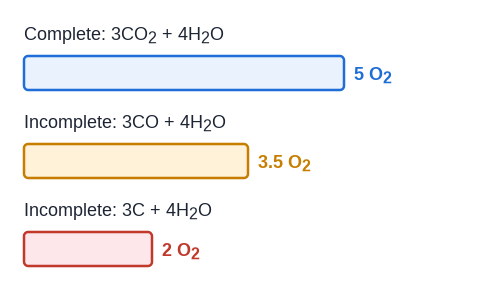
- LPG is mostly propane: C₃H₈ + 5O₂ → 3CO₂ + 4H₂O, a clean blue flame that gives out the most heat.
- With too little oxygen there are not enough O atoms to turn every C atom into CO₂, so some carbon leaves as carbon monoxide or as solid carbon (soot).
- 2C₃H₈ + 7O₂ → 6CO + 8H₂O makes carbon monoxide, a colourless, odourless poison; C₃H₈ + 2O₂ → 3C + 4H₂O makes soot.
- Incomplete combustion shows as a yellow or orange smoky flame, black soot on pots and walls, and less heat from the same fuel.
- Test the products: limewater turns milky with CO₂, and cobalt chloride paper turns from blue to pink with water.
Chemistry bench
Example: a sooty camping burner, written up
- A camping burner with a blocked air hole burns with a yellow flame and leaves black soot on the bottom of the pot.
- Here is how the same idea is written at each grade.
| Grade | Model answer |
|---|---|
| Achieved | This is incomplete combustion. Propane + oxygen → carbon + water, C₃H₈ + 2O₂ → 3C + 4H₂O. The soot is the carbon, and mass is conserved. |
| Merit | The blocked air hole lets in less oxygen. Each propane needs 5 O₂ to turn all 3 C atoms into CO₂, but here there is not enough O, so carbon is left as soot. Both sides have 3 C, 8 H and 4 O. |
| Excellence | No C atoms can disappear, so any carbon that cannot get oxygen must leave as CO or soot. With 3.5 O₂ per propane it forms CO, a poison; with 2 it forms soot. Less of the fuel's energy is released, so it heats the pot more slowly. Clearing the air hole gives the oxygen for complete combustion. |
Precipitation: an insoluble solid from two solutions
- When two solutions of ionic compounds are mixed, the ions swap partners; if one new pairing is insoluble it forms a solid, the precipitate, and the mixture turns cloudy.
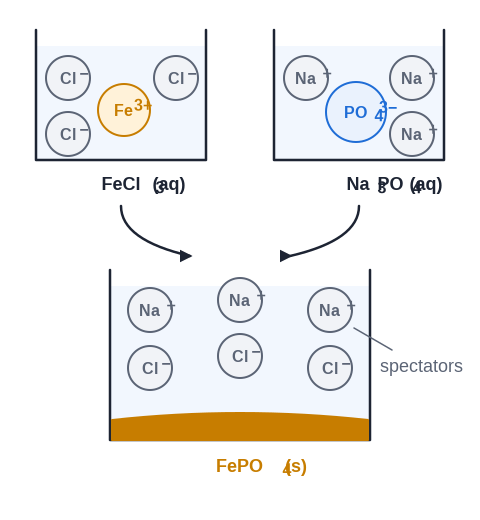
- Use the solubility rules to predict it: FeCl₃(aq) + Na₃PO₄(aq) → FePO₄(s) + 3NaCl(aq), because iron(III) phosphate is insoluble and sodium chloride is soluble.
- Only Fe³⁺ and PO₄³⁻ actually react: Fe³⁺(aq) + PO₄³⁻(aq) → FePO₄(s); Na⁺ and Cl⁻ are spectator ions, dissolved before and after.
- A precipitate forms when the pull between two ions is stronger than the pull of the water molecules around them, so water cannot keep them apart.
- Nothing leaves the container, so the mass of the mixture equals the mass of the two solutions added together.
| Ion | Compounds are usually |
|---|---|
| Na⁺, K⁺, NH₄⁺, NO₃⁻ | soluble, always |
| Cl⁻ | soluble, except with Ag⁺ and Pb²⁺ |
| SO₄²⁻ | soluble, except with Ba²⁺ and Pb²⁺ (Ca²⁺ only slightly) |
| CO₃²⁻, PO₄³⁻, OH⁻ | insoluble, except with Na⁺, K⁺ and NH₄⁺ |
Phosphate in waterways
- Phosphate from fertiliser helps pasture grow, but when it washes into streams and lakes it feeds algae, causing algal blooms that cloud the water and use up oxygen when they die.
- The same ion is useful in the soil and harmful in a lake, so its effect depends on where it ends up and how much there is.
- Precipitation can lock phosphate away: adding aluminium or iron(III) ions makes insoluble solids such as AlPO₄ and FePO₄ that settle to the bottom.
- In Rotorua, alum (aluminium sulfate) is dosed into two streams that flow into Lake Rotorua; the aluminium forms a floc that holds onto dissolved phosphate and settles out, so algae cannot use it.
- Conservation of mass matters here: the phosphorus is not destroyed, only moved into the lake-bed sediment, so it could be released again if conditions in the sediment change.
| Where | What happens to the phosphate |
|---|---|
| Farm soil | taken up by pasture, helping it grow |
| Stream or lake water | dissolved, feeding algal blooms |
| Puarenga and Utuhina Streams, Rotorua | locked into alum floc that settles out |
Combination: two substances become one
- In a combination reaction two or more substances join to make a single product: A + B → AB.
- Iron rusts by combining with oxygen (water is needed too, and real rust also holds water): 4Fe + 3O₂ → 2Fe₂O₃, an orange-brown, flaky solid that weakens tools, gates and car bodies.
- Because oxygen from the air joins the iron, a rusty nail weighs more than it did, by exactly the mass of oxygen it took in.
- A metal combining with a non-metal makes an ionic solid, such as magnesium oxide when magnesium burns: 2Mg + O₂ → 2MgO.
- Two non-metals combining make a molecular compound, usually a gas or liquid: sulfur in fossil fuels combines with oxygen to make sulfur dioxide, S + O₂ → SO₂, which causes acid rain.
Decomposition: one substance breaks apart
- In decomposition one reactant breaks down into two or more simpler products: AB → A + B, often when heated.
- The products can only contain the atoms the reactant had: making water needs H and O, and making carbon dioxide needs C and O.
- Fizzy drinks hold carbonic acid, which breaks down when the bottle is opened: H₂CO₃ → H₂O + CO₂, so the drink fizzes, goes flat and gets lighter as the gas leaves.
- Baking soda decomposes in a hot oven, 2NaHCO₃ → Na₂CO₃ + H₂O + CO₂, and the gas makes a cake rise; more baking soda gives more gas.
- Heating limestone makes lime: CaCO₃ → CaO + CO₂, a metal carbonate giving a metal oxide and carbon dioxide; the solid loses mass because CO₂ escapes.
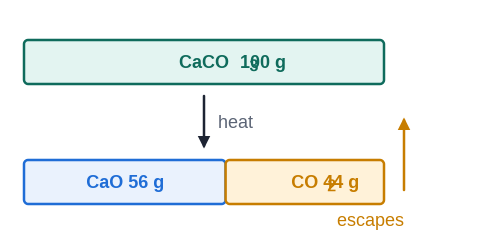
- CaCO₃ → CaO + CO₂Ca 1, C 1, O 3 on each side
- 100 g of CaCO₃ gives 56 g of CaOthe solid left in the kiln
- 100 − 56 = 44 g of CO₂the gas that escapes
- lime making releases CO₂ from the rock itself, not just from the fuel burned to heat it
Observations that identify products
- Linking what you see to a particular substance is how you show a reaction is happening and which type it is.
- A gas can be identified with a simple test, and a colour change can be matched to a substance using a data sheet.
- A change in measured mass is an observation too: a drop usually means a gas escaped, a rise means a gas from the air joined in.
| Observation | What it shows |
|---|---|
| Limewater turns milky | carbon dioxide (Ca(OH)₂ + CO₂ → CaCO₃ + H₂O) |
| Glowing splint relights | oxygen |
| Blue cobalt chloride paper turns pink | water |
| Universal indicator turns green | pH 7, neutralised |
| Two clear solutions go cloudy | a precipitate |
| Blue flame with no soot | complete combustion |
Try it: watch the scale
Example: name the type from what you see
- Decide the reaction type in each case and give the evidence.
- (a) Old copper roofing turns green. (b) Hard water leaves white scale when it is mixed with washing soda. (c) Sherbet fizzes on your tongue.
- (a) combinationcopper, oxygen, carbon dioxide and water from the air join into one green solid, so the roof gets slightly heavier
- (b) precipitationCa²⁺ in the water + CO₃²⁻ from the soda → CaCO₃(s), an insoluble solid
- (c) neutralisationcitric acid + sodium hydrogen carbonate, dissolving in saliva, gives off CO₂
- combination, precipitation, neutralisation
Try it: name the type
Common mistakes
- Incomplete combustion makes less carbon dioxide because some of the carbon is destroyed.No carbon is destroyed; with too little oxygen some carbon atoms leave as carbon monoxide or soot instead of CO₂.
- A rusty nail weighs less because the rust has eaten some of the iron away.Rust contains oxygen taken from the air, so the nail plus its rust weighs more than the clean nail did.
- When silver nitrate and sodium chloride are mixed, every ion forms the precipitate.Only Ag⁺ and Cl⁻ form solid AgCl; Na⁺ and NO₃⁻ are spectator ions that stay dissolved.
- Fizzing always means neutralisation.Fizzing just means a gas is made; a soft drink going flat is decomposition of carbonic acid, not a neutralisation.
Weigh a fizzy drink going flat
You need: two unopened bottles of the same soda water, kitchen scales, a pen and paper, a timer
- Weigh both unopened bottles and write down each mass.
- Open one bottle, put its cap aside, and leave the other one sealed beside it on the bench.
- Weigh both bottles every 10 minutes for an hour, and record the masses in a table.
- Gently swirl the open bottle once after 30 minutes and see whether the next drop is bigger.
- Look for: the sealed bottle's mass stays the same, while the open one gets lighter as carbonic acid decomposes and carbon dioxide escapes, fastest at the start and after swirling.
Safety: Soda water can spray out when the cap is first undone, so open it slowly over the sink, pointed away from your face, and drink only from a clean cup if you drink it afterwards.
Your turn
Name the reaction type: limestone heated in a kiln gives off a gas; two clear solutions are mixed and go cloudy; an iron gate turns orange-brown; lime is spread on an acidic paddock.
Write balanced equations for methane (CH₄) burning completely, and burning incompletely to make carbon monoxide.
Barium nitrate and sodium sulfate solutions are mixed. Name the precipitate, write the balanced equation, and name the spectator ions.
50 g of calcium carbonate is heated until it has all decomposed. What mass of calcium oxide is left, and what mass of carbon dioxide escapes?
A gas heater with no flue is used in a closed bedroom. Discuss why this is dangerous, using combustion equations and conservation of mass.
Explain why an open bottle of fizzy drink gets lighter over an hour, but an unopened one does not.
Show answer
1. Decomposition, precipitation, combination, neutralisation. 2. Complete: CH₄ + 2O₂ → CO₂ + 2H₂O. Incomplete: 2CH₄ + 3O₂ → 2CO + 4H₂O (C 2, H 8, O 6 on each side). 3. Barium sulfate: Ba(NO₃)₂ + Na₂SO₄ → BaSO₄ + 2NaNO₃; Na⁺ and NO₃⁻ are spectators. 4. CaCO₃ → CaO + CO₂, and 100 g gives 56 g CaO and 44 g CO₂, so 50 g gives 28 g of calcium oxide and 22 g of carbon dioxide (28 + 22 = 50). 5. Achieved: methane burns in oxygen; with plenty of air, CH₄ + 2O₂ → CO₂ + 2H₂O. Merit: in a closed room the oxygen is used up, and with too little oxygen there are not enough O atoms to turn every C atom into CO₂, so 2CH₄ + 3O₂ → 2CO + 4H₂O happens instead. Excellence: the carbon atoms cannot disappear, so as oxygen runs short more of them leave as carbon monoxide, which is colourless, odourless and poisonous, and water vapour builds up as well; opening a window or using a flued heater supplies oxygen for complete combustion. 6. Carbonic acid decomposes, H₂CO₃ → H₂O + CO₂, and in the open bottle the CO₂ gas escapes, taking its mass with it; in the sealed bottle every atom stays inside, so the mass is conserved.
Reactants, Products and Leftovers
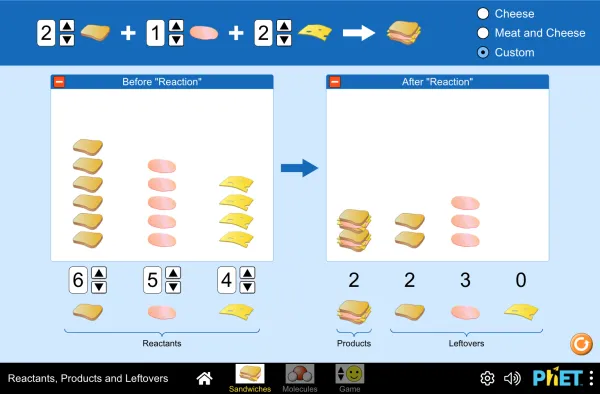
Full screen · PhET Interactive Simulations, University of Colorado Boulder, CC BY 4.0
Recap
- Know the five patterns, then predict products, write the word and balanced equations, and link them to what you see.
- Combustion needs enough oxygen to be complete; too little gives carbon monoxide or soot.
- Solubility rules predict precipitates; spectator ions stay dissolved.
- In every context the atoms are conserved: mass falls only when a gas escapes and rises only when a gas joins, and pollutants are moved, not destroyed.
| Type | Context | Balanced equation |
|---|---|---|
| Neutralisation | antacid | 2HCl + CaCO₃ → CaCl₂ + H₂O + CO₂ |
| Combustion | LPG burner | C₃H₈ + 5O₂ → 3CO₂ + 4H₂O |
| Precipitation | phosphate removal | Fe³⁺ + PO₄³⁻ → FePO₄ |
| Combination | rust | 4Fe + 3O₂ → 2Fe₂O₃ |
| Decomposition | fizzy drink | H₂CO₃ → H₂O + CO₂ |
Challenge
A jar labelled only 'white carbonate' could hold calcium carbonate, magnesium carbonate or sodium hydrogen carbonate. When heated fully, 100 g of calcium carbonate leaves 56 g of solid, 84 g of magnesium carbonate leaves 40 g, and 168 g of sodium hydrogen carbonate leaves 106 g. A student heats 10.0 g of the powder until the mass stops changing; 5.6 g of white solid is left and the gas given off turns limewater milky. (a) Which compound is it? Show your reasoning for all three. (b) Name the reaction type and write its balanced equation. (c) The leftover solid is added to water: the mixture warms up and universal indicator turns purple. Name the reaction type, write the balanced equation, and explain why breathing out through a straw into the filtered liquid makes it go cloudy.
Hint
Scale each given result down to 10.0 g and see which matches 5.6 g. Then think: a metal oxide plus water joins into one substance, and that substance is limewater.
Answer
(a) Calcium carbonate: 10.0 g would leave 5.6 g, against about 4.8 g for magnesium carbonate and about 6.3 g for sodium hydrogen carbonate. (b) Decomposition: CaCO₃ → CaO + CO₂. (c) Combination: CaO + H₂O → Ca(OH)₂, an alkali (purple indicator); exhaled CO₂ reacts with it, Ca(OH)₂ + CO₂ → CaCO₃ + H₂O, and insoluble calcium carbonate forms as a cloudy precipitate.
Step by step
- Calcium carbonate keeps 56 out of every 100 g, so 10.0 g keeps 5.6 g, an exact match.
- Magnesium carbonate keeps 40 out of 84, about 4.8 g, and sodium hydrogen carbonate keeps 106 out of 168, about 6.3 g, so neither fits.
- One substance breaks into two, with carbon dioxide leaving, so it is decomposition; the mass lost is the CO₂.
- Calcium oxide and water join into one product, calcium hydroxide, so it is combination; it is alkaline, so the indicator turns purple.
- Calcium hydroxide solution is limewater: CO₂ from your breath forms solid calcium carbonate, which makes it cloudy.
Full working
- CaCO₃: 10.0 × 56 ÷ 100 = 5.6 gmatches
- MgCO₃: 10.0 × 40 ÷ 84 ≈ 4.8 gtoo low
- NaHCO₃: 10.0 × 10⁶ ÷ 168 ≈ 6.3 gtoo high
- CaCO₃ → CaO + CO₂, CO₂ lost = 10.0 − 5.6 = 4.4 gdecomposition, Ca 1, C 1, O 3 each side
- CaO + H₂O → Ca(OH)₂combination, Ca 1, O 2, H 2 each side
- Ca(OH)₂ + CO₂ → CaCO₃ + H₂OCa 1, O 4, H 2, C 1 each side
- calcium carbonate; decomposition, then combination, then cloudy CaCO₃ with exhaled CO₂
In a caravan, a propane heater with a partly blocked air vent is tested. For every 2 propane molecules (C₃H₈) burned, only 8 oxygen molecules are used, all the hydrogen ends up as water, and no soot forms. (a) Work out how many carbon dioxide and how many carbon monoxide molecules form, and write the balanced equation. (b) What fraction of the carbon leaves as carbon monoxide? (c) How many more oxygen molecules per 2 propane would give complete combustion? (d) Use conservation of mass to explain why fixing the vent does not change the mass of carbon leaving the heater, only the gas it leaves in.
Hint
2 C₃H₈ hold 6 C and 16 H. Make the water first and count how many O atoms that uses out of the 16 supplied. Share the O atoms left among the 6 carbons: a carbon with 2 O is CO₂, a carbon with 1 O is CO.
Answer
(a) 2 CO₂ and 4 CO: 2C₃H₈ + 8O₂ → 2CO₂ + 4CO + 8H₂O. (b) Two thirds (4 of the 6 carbons). (c) 2 more, since complete combustion is 2C₃H₈ + 10O₂ → 6CO₂ + 8H₂O. (d) No carbon atoms are made or destroyed, so the same 6 carbon atoms leave either way; more oxygen only means each carbon atom leaves joined to two oxygen atoms (harmless CO₂) instead of one (poisonous CO).
Step by step
- 16 hydrogen atoms make 8 water molecules, which use 8 of the 16 oxygen atoms.
- That leaves 8 oxygen atoms for 6 carbon atoms.
- If a carbon atoms become CO₂ and b become CO, then a + b = 6 and 2a + b = 8, so a = 2 and b = 4.
- Complete combustion needs 2 O per carbon plus the water's oxygen: 12 + 8 = 20 O atoms, or 10 O₂.
- Atoms are only rearranged, so the carbon's mass is the same; the oxygen supply decides which product it ends up in.
Full working
- 2C₃H₈: C 6, H 16; 8O₂: O 16atoms supplied
- 16 H → 8H₂O, using 8 Oall hydrogen to water
- O left = 16 − 8 = 8for the carbon
- a + b = 6 and 2a + b = 8, so a = 2, b = 4CO₂ and CO
- 2C₃H₈ + 8O₂ → 2CO₂ + 4CO + 8H₂O; right O = 4 + 4 + 8 = 16balanced
- CO fraction = 4 ÷ 6 = 23; complete needs 10O₂, so 2 more2C₃H₈ + 10O₂ → 6CO₂ + 8H₂O
- 2CO₂ and 4CO, two thirds of the carbon as CO, 2 more O₂ needed
Four unlabelled bottles A, B, C and D hold silver nitrate, barium chloride, sodium carbonate and hydrochloric acid, in some order. A student mixes a few drops of each pair: A + B white precipitate; A + C fizzing; A + D pale precipitate; B + C no change; B + D white precipitate; C + D white precipitate. (a) Identify A, B, C and D, giving your reasons. (b) For A + C, name the reaction type and write the balanced equation. (c) For B + D, write the balanced equation, the ionic equation for the precipitate, and name the spectator ions. (d) Each pair was mixed in an open test tube on a balance. Which pair's reading would fall, and why do the precipitate pairs not lose mass?
Hint
Use the solubility rules: chlorides are soluble except with Ag⁺ and Pb²⁺; carbonates are insoluble except with Na⁺, K⁺ and NH₄⁺. Only one pair can fizz: an acid meeting a carbonate. Count how many precipitates each bottle gives.
Answer
(a) A sodium carbonate, B barium chloride, C hydrochloric acid, D silver nitrate. (b) Neutralisation: Na₂CO₃ + 2HCl → 2NaCl + H₂O + CO₂. (c) BaCl₂ + 2AgNO₃ → 2AgCl + Ba(NO₃)₂; Ag⁺ + Cl⁻ → AgCl; spectators Ba²⁺ and NO₃⁻. (d) Only A + C falls, because CO₂ gas escapes; a precipitate is a solid that stays in the tube, so every atom is still weighed.
Step by step
- Fizzing needs an acid and a carbonate, so A and C are sodium carbonate and hydrochloric acid in some order.
- D gives a precipitate with all three: Ag⁺ forms AgCl with both chlorides and silver carbonate with the carbonate, so D is silver nitrate.
- B + C give nothing, and barium chloride with hydrochloric acid gives no insoluble pair, so B is barium chloride and C is hydrochloric acid.
- That makes A sodium carbonate, which fits A + B: Ba²⁺ and CO₃²⁻ make insoluble BaCO₃.
- In B + D only Ag⁺ and Cl⁻ join; Ba²⁺ and NO₃⁻ stay dissolved, so they are spectators.
Full working
- A + C fizz → acid + carbonateso {A, C} = {Na₂CO₃, HCl}
- D: precipitate with A, B and C → AgNO₃AgCl and Ag₂CO₃ are insoluble
- B + C no change → BaCl₂ + HClno insoluble pair
- A + B: BaCl₂ + Na₂CO₃ → BaCO₃ + 2NaClconfirms A is the carbonate
- Na₂CO₃ + 2HCl → 2NaCl + H₂O + CO₂Na 2, C 1, O 3, H 2, Cl 2 each side
- BaCl₂ + 2AgNO₃ → 2AgCl + Ba(NO₃)₂; Ag⁺ + Cl⁻ → AgClBa 1, Cl 2, Ag 2, N 2, O 6 each side
- A Na₂CO₃, B BaCl₂, C HCl, D AgNO₃; only A + C loses mass, as CO₂
Report a mistake
How is NCEA Level 1 maths going?
See the NCEA Level 1 maths guide