The nervous system: brain, spinal cord and nerves
What this lesson covers
- The central nervous system: the brain and the spinal cord
- The cerebrum, cerebellum and brainstem, and the job of each
- The peripheral nervous system of nerves running through the body
- The difference between voluntary actions and automatic responses
- How receptors detect stimuli
- Planning a safe, fair reaction time experiment
Why you need a nervous system
- Your body has to notice changes around it and inside it, then respond in time, often in a fraction of a second.
- The nervous system does this by sending electrical signals along nerve cells, called neurons.
- The fastest neurons carry signals at up to about 100 metres per second, so a message from your toe reaches your spinal cord in about one hundredth of a second.
Central and peripheral
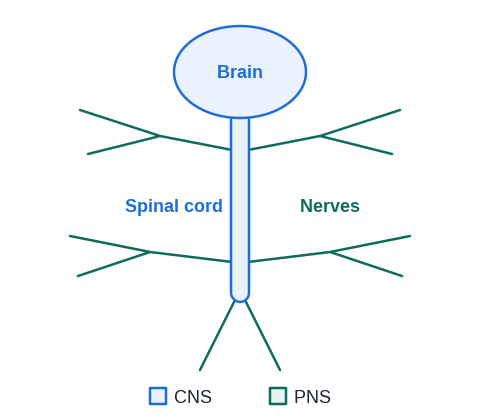
- The central nervous system (CNS) is made of the brain and the spinal cord. It takes in information, decides what it means and sends out instructions.
- The brain is protected by the skull, and the spinal cord runs down inside the backbone, protected by the vertebrae.
- The peripheral nervous system is every nerve outside the brain and spinal cord, branching out to your skin, muscles and organs.
- A nerve is a bundle of many neurons wrapped together, like a cable holding many wires.
| Part | Made of | Main job |
|---|---|---|
| Central nervous system | Brain and spinal cord | Receives information, processes it, sends instructions |
| Peripheral nervous system | Nerves throughout the body | Carries signals between the CNS and the rest of the body |
Body explorer
The brain and its three main regions
- The human brain contains about 86 billion neurons, each linked to thousands of others, which lets it take in, sort and send huge amounts of information.
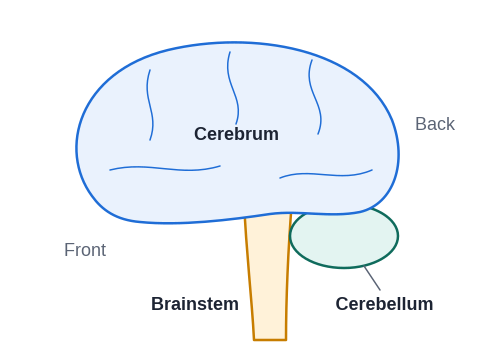
- The cerebrum is the large, wrinkled top part. It handles conscious thinking, memory, language, the senses and the movements you choose to make.
- The cerebellum sits at the back, under the cerebrum. It coordinates your muscles so movement is smooth, and keeps you balanced.
- The brainstem joins the brain to the spinal cord. It runs life-support functions you never think about, such as breathing, heart rate and swallowing.
| Region | Where it is | Controls | Example |
|---|---|---|---|
| Cerebrum | Top, largest part | Thought, memory, senses, chosen movement | Solving a maths problem, deciding to wave |
| Cerebellum | Back, below the cerebrum | Coordination and balance | Riding a bike, walking along a beam |
| Brainstem | Base, joining the spinal cord | Automatic body functions | Breathing while asleep, heartbeat |
Which region is it?
- A rugby player is tackled and hits his head. Doctors check what he can still do to judge where the injury is.
- Match each problem to the brain region most likely affected.
- He cannot remember the score of the gamememory and thought: cerebrum
- He staggers and cannot walk in a straight linebalance and coordination: cerebellum
- His breathing becomes irregularautomatic function: brainstem, the most dangerous sign
- Memory: cerebrum. Balance: cerebellum. Breathing: brainstem
Voluntary or automatic
- A voluntary action is one you decide to do, such as kicking a ball or writing your name, and it starts in the cerebrum.
- An automatic response happens without you choosing it, such as your heartbeat, breathing while you sleep or blinking when something flies at your eye.
- A reflex is a fast automatic response that protects you, such as pulling your hand off a hot pan before you even feel the pain.
- Some actions can be both: you breathe automatically, but you can also choose to hold your breath for a while.
| Action | Voluntary or automatic | Reason |
|---|---|---|
| Catching a ball | Voluntary | You choose to reach for it |
| Heartbeat | Automatic | Controlled without thought by the brainstem |
| Knee jerk when tapped | Automatic (reflex) | Happens before you can decide |
| Pupils shrinking in bright light | Automatic (reflex) | Protects the eye without thought |
Try it: voluntary or automatic?
Receptors detect stimuli
- A stimulus is any change that the body can detect, inside or outside it, such as a flash of light, a loud noise or a drop in temperature.
- A receptor is a cell or group of cells that detects a particular kind of stimulus and starts a nerve signal.
- Your sense organs are packed with receptors, and each kind of receptor responds best to one kind of stimulus.
- There are also receptors inside you, for example ones that sense stretch in your muscles and others that sense the level of carbon dioxide in your blood.
| Sense organ | Receptors detect | Stimulus example |
|---|---|---|
| Eye | Light | A traffic light turning red |
| Ear | Sound, and head position for balance | Someone calling your name |
| Skin | Touch, pressure, pain, heat and cold | A mosquito landing on your arm |
| Nose | Chemicals in the air | The smell of a hāngī |
| Tongue | Chemicals in food | Sour taste of a lemon |
Try it: a signal round the body
Testing reaction time: the ruler drop
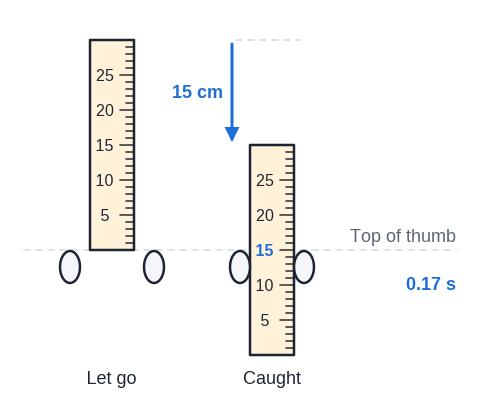
- A partner holds a 30 cm ruler vertically with the zero mark level with the top of your thumb. You hold your thumb and finger open around it without touching.
- Without warning they let go, and you catch it as fast as you can. Read the distance it fell at the top of your thumb.
- A shorter drop means a faster reaction, and the distance can be turned into a time using the table below.
- To test a question such as whether your dominant hand reacts faster, change only the hand, measure the drop distance, and keep everything else the same.
- Make it ethical and safe: everyone agrees to take part, nobody is pressured or teased about results, and a light ruler is used so a missed catch cannot hurt.
| Drop distance (cm) | Reaction time (s) |
|---|---|
| 5 | 0.10 |
| 10 | 0.14 |
| 15 | 0.17 |
| 20 | 0.20 |
| 25 | 0.23 |
Planning the dominant-hand test
- Aroha wants to know whether her right hand (her writing hand) reacts faster than her left.
- Lay out her variables and decide what result would answer the question.
- Change: which hand catchesindependent variable
- Measure: drop distance in cm, converted to secondsdependent variable
- Keep the same: ruler, dropper, starting gap, sitting position, time of daycontrolled variables
- Five catches with each hand, alternating handsrepeats reduce chance effects; alternating stops one hand getting all the practice
- Right hand average 0.17 s, left hand 0.20 sexample result
- A consistently smaller right-hand time supports the idea that the dominant hand is faster
Try it: catch the ruler
Common mistakes
- The brainstem controls balance.The cerebellum coordinates movement and balance; the brainstem runs automatic functions such as breathing and heart rate.
- The spinal cord is part of the peripheral nervous system, because it runs down the back.The spinal cord is part of the central nervous system with the brain; the peripheral nervous system is the nerves outside them.
- A nerve is one long nerve cell.A nerve is a bundle of many neurons wrapped together, like a cable holding many wires.
- In the ruler drop, the stimulus is the eye.The stimulus is the change, the ruler starting to fall; the eye is the sense organ whose receptors detect it.
Map your touch receptors
You need: a paper clip, a ruler, a partner, pen and paper
- Bend a paper clip into a U shape with its two ends side by side, and use the ruler to set the gap between the ends to 1 cm.
- Your partner closes their eyes. Touch their skin lightly, sometimes with both ends at once and sometimes with only one, and ask them to say one or two each time.
- Test the fingertip, the palm, the back of the hand and the forearm, with about five touches on each.
- On each place, make the gap smaller or bigger until you find the smallest gap that still feels like two points, and write it down.
- Look for: the fingertip can tell two points apart when they are only a few millimetres apart, while on the forearm two points 3 cm apart can still feel like one, because the fingertips have far more touch receptors packed into each square centimetre.
Safety: The ends of a paper clip can scratch, so touch lightly, stay on the hand and arm, and keep it well away from the face and eyes.
Your turn
Name the two parts of the central nervous system.
A gymnast keeps her balance on a narrow beam. Which brain region is mainly responsible?
Sort into voluntary or automatic: sneezing, texting a friend, your stomach churning food, choosing a lunch.
Name the stimulus and the sense organ that detects it when you hear a fire alarm.
In the ruler drop test, why should the dropper not count down before letting go?
Tama says the spinal cord is part of the peripheral nervous system because it runs down the back. What is the correct idea?
In a ruler drop test, Mere's ruler falls 10 cm and Tom's falls 20 cm. If 10 cm is 0.14 s and 20 cm is 0.20 s, who reacted faster and in what time?
Two points 3 mm apart feel like two on a fingertip, but two points 3 cm apart can feel like one on the forearm. Why?
Show answer
1. The brain and the spinal cord. 2. The cerebellum, which coordinates movement and balance. 3. Automatic: sneezing, stomach churning food. Voluntary: texting a friend, choosing a lunch. 4. The stimulus is sound; the ear detects it. 5. A countdown lets the catcher predict the moment, so you measure guessing rather than reaction; the drop must come without warning to measure the true reaction time. 6. The spinal cord is part of the central nervous system with the brain; the peripheral nervous system is the nerves outside them. 7. Mere, in 0.14 s: a shorter drop means a faster reaction, and 10 cm converts to 0.14 s. 8. The fingertips have far more touch receptors packed into each square centimetre, so they can tell two close points apart.
What to take away
- The central nervous system is the brain and spinal cord; the peripheral nervous system is the nerves everywhere else.
- The cerebrum handles thought and chosen movement, the cerebellum coordination and balance, and the brainstem automatic functions like breathing.
- Some actions are voluntary and some, including reflexes and the heartbeat, are automatic.
- Receptors detect stimuli, which are changes inside or outside the body.
- A fair reaction time test changes one thing, measures one thing, keeps the rest the same, repeats, and is safe and willingly done.
Challenge
A driver is going along a suburban street in Hamilton at 50 km per hour when a child runs out between two parked cars. (a) Name the stimulus, the sense organ and the receptors that detect it. (b) Which brain region decides to brake, and which region makes the leg move smoothly from the accelerator to the brake? Is pressing the brake voluntary or automatic? (c) An alert driver takes 0.75 s to start braking. A driver reading a text takes 1.5 s. How far does each car travel before the brakes even come on, and how much further is that for the texting driver? (1 m s⁻¹ = 3.6 km per hour.)
Hint
The stimulus is the change, not the thing that detects it. Change the speed into metres per second first, then distance = speed × time.
Answer
(a) Stimulus: light from the child suddenly moving into the road; sense organ: the eye; receptors: light receptors in the retina. (b) The cerebrum decides, the cerebellum coordinates the leg; braking is voluntary because the driver chooses it. (c) About 10.4 m for the alert driver and 20.8 m for the texting driver, about 10.4 m further.
Step by step
- The stimulus is the change the body detects: the child appearing, seen as light.
- Choosing to brake is a conscious decision made in the cerebrum; smooth, timed movement is coordinated by the cerebellum.
- Change 50 km per hour into metres per second by dividing by 3.6.
- Multiply speed by each reaction time; the car keeps going at full speed until the brakes come on.
- Doubling the reaction time doubles the distance covered before braking starts.
Full working
- 50 ÷ 3.6 ≈ 13.9 m s⁻¹speed in metres per second
- Alert: 13.9 × 0.75 ≈ 10.4 mdistance = speed × time
- Texting: 13.9 × 1.5 ≈ 20.8 mdistance = speed × time
- 20.8 − 10.4 = 10.4 mextra distance
- Eye (light receptors); cerebrum decides; cerebellum coordinates; voluntary
- About 10.4 m against 20.8 m: the texting driver travels about 10.4 m further before braking
Tane is injured in a fall, and his spinal cord is cut completely in the middle of his back, below the nerves to his arms and above the nerves to his legs. His legs, the nerves in his legs and his leg muscles are not damaged. (a) He cannot feel a pin prick on his foot, and he cannot move his legs when he tries. Explain why both feeling and movement are lost, when the receptors and muscles still work. (b) He can still move his arms, talk and breathe normally. Explain why. (c) A doctor taps just below his kneecap and his lower leg kicks forward, but Tane feels nothing. What does this tell the doctor about the part of the spinal cord below the cut, and why is the kick not a voluntary action?
Hint
The spinal cord carries signals both ways between the body and the brain. Ask which signals have to cross the cut and which do not. A knee jerk does not need the brain.
Answer
(a) Feeling needs signals from the foot's receptors to travel up the spinal cord to the cerebrum, and moving on purpose needs instructions from the cerebrum to travel down it; both must cross the cut, so neither gets through. (b) The nerves to his arms, and the brainstem that runs breathing, join the central nervous system above the cut, so their signals never have to cross it. (c) The spinal cord below the cut and the nerves to and from the leg still work, because the knee jerk is a reflex that runs through the spinal cord without needing the brain. It is not voluntary because it happens without any decision by the cerebrum, which is cut off from the leg.
Step by step
- Voluntary movement starts in the cerebrum, and feeling happens in the cerebrum, so both need the spinal cord as the route between brain and legs.
- A cut cord blocks the route in both directions, even if both ends still work.
- Everything that joins the central nervous system above the cut, including the arms and breathing control in the brainstem, still works.
- A knee jerk is an automatic reflex that only needs the leg's nerves and the spinal cord near the knee's level, so it still happens.
- Because the signal cannot reach the brain, Tane feels nothing and does not choose the kick.
Full working
- Pin prick: receptor, nerve, spinal cord, cutsignal cannot reach the cerebrum, no feeling
- Choosing to move: cerebrum, spinal cord, cutinstruction cannot reach the leg muscles
- Arms and breathing: join above the cutsignals do not cross it
- Knee tap: receptor, nerve, spinal cord below the cut, nerve, thigh muscleno brain needed
- The cut blocks signals both ways; the reflex shows the lower spinal cord and leg nerves still work
Mere wants to know whether her right (writing) hand catches a dropped ruler faster than her left. Session 1: she does five catches with her right hand and then five with her left. Drop distances in order (cm): right 22, 20, 19, 18, 16; left 15, 14, 14, 13, 14. She concludes her left hand is faster. Session 2, a week later: she alternates hands, starting with the right. Drop distances in order (cm): right 16, left 21, right 15, left 20, right 14, left 19. Use the table from the lesson: 15 cm is 0.17 s and 20 cm is 0.20 s. (a) Find the mean drop for each hand in session 1. (b) Using the pattern in the order of the results, explain why session 1 cannot be trusted. (c) Find the mean drop and reaction time for each hand in session 2. What does session 2 suggest? (d) Give one reason even session 2 cannot show that writing hands are faster for people in general, and one more change to make the test fairer.
Hint
Look at how the distances change from one catch to the next within session 1, regardless of hand. In session 2, does alternating give each hand the same chance to benefit?
Answer
(a) Right 19 cm, left 14 cm. (b) The drop gets shorter on almost every catch, so Mere is improving with practice; all the left-hand catches came after all the right-hand ones, so the left hand looks faster just because it went second. (c) Right 15 cm (0.17 s), left 20 cm (0.20 s): with practice shared fairly, her right hand is about 0.03 s faster. (d) Only one person was tested, so it cannot be generalised; test many people. Fairer: start with the left hand in half the sessions (or for half the people), or give practice catches first.
Step by step
- Add the five distances for each hand and divide by 5.
- In session 1 the distances fall steadily through all ten catches, which is a practice effect, not a hand effect.
- Because every left catch came later, practice and hand are mixed up, so the result cannot separate them.
- Alternating spreads the practice across both hands; both still improve by 1 cm each round, but the right stays 5 cm ahead.
- Converting with the table, the right hand is faster, but one person's result does not show what is true for everyone.
Full working
- Session 1 right: (22 + 20 + 19 + 18 + 16) ÷ 5 = 95 ÷ 5 = 19 cmmean
- Session 1 left: (15 + 14 + 14 + 13 + 14) ÷ 5 = 70 ÷ 5 = 14 cmmean
- 22 → 16, then 15 → 13steady improvement: practice, not hand
- Session 2 right: (16 + 15 + 14) ÷ 3 = 15 cm = 0.17 sfrom the table
- Session 2 left: (21 + 20 + 19) ÷ 3 = 20 cm = 0.20 sfrom the table
- 0.20 − 0.17 = 0.03 sright hand faster
- Session 1 is biased by practice; session 2 suggests her right hand is about 0.03 s faster
The maths behind it
Report a mistake
How is Year 10 maths going?
See the Year 10 maths guide