Water in ecosystems: soil, plants and transpiration

What this lesson covers
- How water and nutrients keep moving between living things and their surroundings
- How the amount of freshwater affects where organisms live, how they behave and whether they survive
- Soil as a store of water and dissolved nutrients
- How plants take in water and use it
- Transpiration and its effect on humidity and rain
- How wetlands, forests and grasslands differ in water and in life
- Ways people have harmed and helped ecosystems
Materials go round and round
- An ecosystem is all the living things in an area together with their non-living surroundings: soil, water, air and rock.
- Energy flows through an ecosystem and is eventually lost as heat, but materials such as water, carbon and nitrogen are reused again and again.
- Water falls as rain, soaks into soil, is taken up by plants, passes to animals that eat them or drink, and returns to the air by evaporation and transpiration.
- Nutrients travel the same loop: dissolved in soil water, taken up by roots, built into living things, then returned to the soil when they die and rot.
- If any part of the loop is blocked, for example by drought, the whole ecosystem feels it.
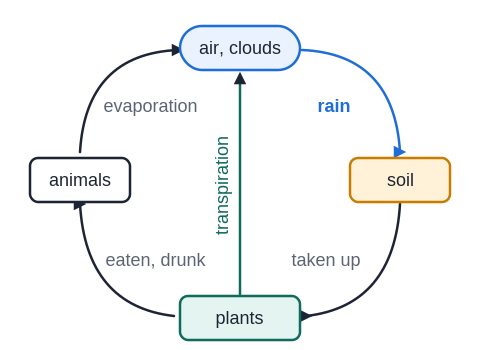
Try it: water moving round
Freshwater decides who lives where
- Every living thing needs water, so how much freshwater is available limits which organisms can live in a place.
- It affects distribution: kahikatea grows in swampy ground where many other trees would drown, while mānuka copes with drier, poorer soils.
- It affects behaviour: tuna (eels) can travel short distances over wet grass at night to reach new waterways, and many animals feed at dawn and dusk to avoid drying out.
- It affects survival: in a drought, small streams dry up and fish and kōura (freshwater crayfish) trapped in shrinking pools can die.
Soil is a sponge and a pantry
- Soil is a mix of rock particles, decaying organic matter, air, water and countless living things.
- Water clings in the small spaces between soil particles, so soil holds water long after rain has stopped.
- Nutrients such as nitrogen, phosphorus and potassium are dissolved in that soil water, which is how plants get them.
- Soil rich in organic matter holds more water and nutrients, so more plants can grow, which supports more animals: the ecosystem is more productive.
- Sandy soil drains fast and dries out, while clay soil holds a lot of water but can become waterlogged.
| Soil type | Water holding | Effect on plants |
|---|---|---|
| Sandy | Low: drains quickly | Dries out; suits drought-tolerant plants |
| Clay | High: drains slowly | Can waterlog and starve roots of air |
| Loam rich in organic matter | Good, and drains well | Best for most plant growth and crops |
How plants take in and use water
- Roots are covered in tiny root hairs that give a huge surface area for water to enter by osmosis.
- Water travels up the plant in narrow tubes called xylem, all the way to the leaves.
- In the leaves, water is a raw material for photosynthesis: carbon dioxide and water, using light energy, make glucose and oxygen.
- Water also carries dissolved nutrients around the plant, and it keeps cells firm so soft stems and leaves stand up; a plant that runs short wilts.
| Use of water | What it does |
|---|---|
| Photosynthesis | Raw material for making glucose |
| Transport | Carries dissolved minerals up the xylem |
| Support | Keeps cells firm so the plant does not wilt |
| Cooling | Evaporating from leaves cools the plant |
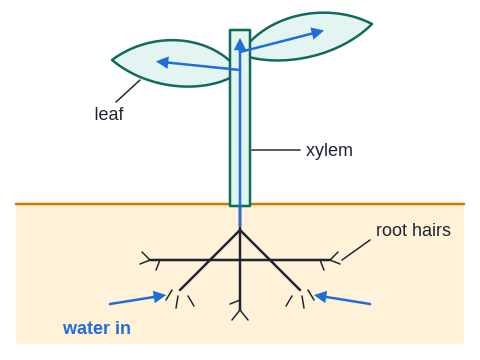
Transpiration: plants put water back in the air
- Most of the water a plant takes up is not kept; it evaporates from inside the leaves and escapes as water vapour through tiny pores called stomata.
- This loss of water vapour from leaves is called transpiration, and it pulls more water up through the plant from the roots.
- Transpiration is faster when it is hot, sunny, dry and windy.
- A large forest releases so much water vapour that it raises the humidity of the air and can help clouds form, and much of the rain over the Amazon comes from water the forest itself transpired.
- Clearing forest can therefore make a region drier, not just lose the trees.
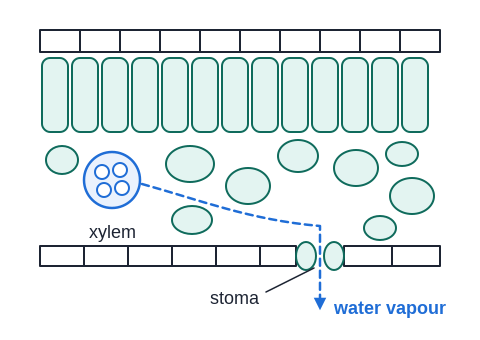
Try it: a potometer
Measuring transpiration with plastic bags
- A student ties clear plastic bags over leafy branches of the same plant, one in the sun and one in the shade, and collects the water after 24 hours.
| Branch | Water collected (mL) |
|---|---|
| In sun | 12 |
| In shade | 5 |
- Changed: sun or shadeindependent variable
- Measured: water collected in the bagdependent variable
- Same: plant, number of leaves, bag size, timecontrolled variables
- 12 ÷ 5 = 2.4sun branch lost about 2.4 times as much water
- Warmth and light speed up transpiration
Different ecosystems, different water
- A wetland is land that is waterlogged or flooded for much of the year; plants such as raupō and harakeke have roots that cope with little air in the soil.
- A forest catches rain in its canopy and leaf litter, keeps the ground moist and shaded, and supports many layers of life from mosses to tall trees.
- A tussock grassland gets less rain or drains quickly, so plants grow in tough clumps that lose little water, and fewer trees can grow.
- Because each ecosystem has a different water supply, each has a different mix of organisms.
| Ecosystem | Water | Typical NZ organisms |
|---|---|---|
| Wetland | Waterlogged or flooded | Raupō, harakeke, kahikatea, pūkeko, tuna |
| Forest | Moist, shaded, steady | Tree ferns, rimu, mosses, kererū |
| Tussock grassland | Drier, often windy and cold | Tussock grasses, skinks, grasshoppers |
Food web
Wet versus dry: a transect along a stream
- A class lays a tape from the edge of a stream up the bank and places a square frame (quadrat) every 2 metres.
- In each quadrat they measure soil moisture and count the plant species, and they note signs from the land such as which plants are flowering, where pūkeko feed and how fast the stream is flowing, the kind of observation called ngā tohu o te taiao.
| Distance from stream (m) | Soil moisture (%) | Plant species | Main plants |
|---|---|---|---|
| 0 | 62 | 3 | Raupō, sedges |
| 2 | 48 | 6 | Harakeke, sedges, grasses |
| 4 | 30 | 8 | Grasses, mānuka seedlings |
| 6 | 18 | 5 | Grasses, gorse |
- Moisture falls steadily from 62% to 18% moving away from the streamread down the moisture column
- Plant types change from wetland plants to dry-ground plantsdifferent species suit different water
- Species peak at 4 m, where neither flooding nor drying is extrememiddle conditions suit the most species
- Prediction: in a dry summer the raupō zone would shrink towards the stream
Try it: up the stream bank
People change ecosystems, for worse and better
- Kina barrens: where snapper and crayfish were overfished, kina had fewer predators, multiplied and grazed kelp forests down to bare rock.
- At Goat Island marine reserve near Leigh, NZ's first marine reserve, fishing stopped, the predators returned, kina numbers fell and the kelp grew back.
- Rainforests are cleared for farming and timber, and coral reefs bleach when seas warm, harming huge numbers of species.
- Predator-free sanctuaries such as Zealandia in Wellington fence out rats, stoats and possums, and native birds have recovered inside and spread beyond the fence.
| Example | Impact | Effect |
|---|---|---|
| Kina barrens | Negative | Overfishing removed kina predators, so kelp forests were lost |
| Marine reserves | Positive | Predators return and kelp forests regrow |
| Rainforest clearing | Negative | Habitat loss and a drier local climate |
| Predator-free sanctuaries | Positive | Native birds and insects recover |
Common mistakes
- Plants keep most of the water their roots take in and use it for photosynthesis.Most of it is lost as water vapour through the stomata by transpiration; only a small fraction is used in photosynthesis.
- Transpiration is the plant sweating out water through its roots.Transpiration is water evaporating from inside the leaves and escaping through the stomata, which pulls more water up the xylem from the roots.
- Clay soil is the best soil because it holds the most water.Clay can become waterlogged and starve roots of air, so loam rich in organic matter, which holds water and still drains, suits most plants best.
- Water and nutrients flow through an ecosystem and are lost, the same as energy.Energy is eventually lost as heat, but water and nutrients are recycled again and again between living things and their surroundings.
Which soil holds the most water?
You need: 3 same-size plant pots with drainage holes, paper towels, a cup each of sand, garden soil and potting mix or compost, 3 glasses or jars, a measuring jug, water
- Put a square of paper towel in the bottom of each pot so the soil does not fall out, then fill each pot with one cup of a different soil. If any sample is bone dry, mix in a little water first so all three start just damp.
- Stand each pot on top of a glass or jar so water can drain into it.
- Slowly pour 250 mL of water evenly over each pot.
- After 10 minutes, pour the water from each glass into the measuring jug and record it.
- Work out the water each soil held: 250 mL minus the water that drained through.
- Look for the sand letting most of the water through and the soil richest in organic matter holding the most: that stored water is what plant roots draw on long after rain has stopped.
Safety: Potting mix and compost can carry Legionella bacteria, which causes a serious lung infection in NZ every year, so open bags away from your face, keep the mix damp so it does not make dust, wear gloves and wash your hands afterwards.
Your turn
Give three ways a plant uses the water its roots take up.
Why does a plant on a hot, windy day need more water from the soil?
Why can soil rich in organic matter support more life than sandy soil?
In the stream transect, which reading would you expect to change most after two weeks of heavy rain, and why?
Explain how overfishing of snapper can lead to the loss of a kelp forest.
Which statement about transpiration is true?
Each soil gets 250 mL of water. 190 mL drains through the sand and 70 mL through the potting mix. Which held more, and how much?
Why could clearing a large forest make the local region drier, not just remove the trees?
Show answer
1. Any three: photosynthesis, carrying dissolved minerals, keeping cells firm for support, cooling the leaves. 2. Transpiration is faster when it is hot and windy, so it loses more water from its leaves and must replace it through its roots. 3. Organic matter holds more water and nutrients, so more plants grow, which feeds more animals; sandy soil drains and dries quickly. 4. Soil moisture, especially further from the stream, because rain soaks the drier soil; the plant species take much longer to change. 5. Snapper eat kina; with fewer snapper, kina numbers rise and they graze the kelp until only bare rock is left. 6. Water evaporates inside the leaves and escapes as vapour through the stomata, and this pulls more water up the xylem from the roots. 7. Water held is 250 mL minus what drained: sand 250 − 190 = 60 mL, potting mix 250 − 70 = 180 mL, so the potting mix held more, 180 mL. 8. A forest transpires so much water vapour that it raises humidity and helps clouds form, so without it there is less vapour to feed rain.
What to take away
- Water and nutrients cycle continuously between organisms and their surroundings.
- How much freshwater there is affects where organisms live, how they behave and whether they survive.
- Soil stores water and dissolved nutrients, which makes ecosystems more productive.
- Plants take water in through root hairs and use it for photosynthesis, transport and support, then release it by transpiration through stomata.
- Transpiration raises humidity and can feed rain, so forests help make their own weather.
- Wetlands, forests and grasslands have different water supplies and so different organisms, and human choices can damage or restore them.
Challenge
A class fills three pots with sand, loam and clay, and slowly pours 250 mL of water onto each. After 10 minutes, 205 mL has drained out of the sand and 95 mL out of the loam. Only 30 mL has drained out of the clay, and another 30 mL is still lying as a puddle on top of it. A seedling is then planted in each pot. Each seedling transpires 25 mL of water a day, and no more water is added. A plant cannot pull out the last 25 mL of water held in sand or loam, and it cannot pull out the last 70 mL held in clay, because water clings very tightly to the tiny clay particles. (a) How much water does each soil hold? (b) For how many days can each seedling keep transpiring before it starts to wilt? (c) The clay held the most water, so why is it not the best soil here, and what extra problem would clay give in a very wet winter?
Hint
The puddle on top of the clay has not soaked in, so it is not held by the soil. Only the water a plant can actually pull out is useful to it.
Answer
(a) Sand 45 mL, loam 155 mL, clay 190 mL. (b) Sand 0.8 days, loam 5.2 days, clay 4.8 days. (c) Much of the water in clay clings too tightly for roots to use, so loam gives the plant more usable water. In a wet winter clay drains so slowly it becomes waterlogged, and the roots are starved of air.
Step by step
- Water held is what went in minus what drained out, and for clay also minus the puddle that never soaked in.
- Usable water is the water held minus the part the plant cannot pull out.
- Divide the usable water by 25 mL a day to get the number of days.
- Loam lasts longest even though clay holds the most, because so much of the clay's water is locked to its particles.
- Clay also drains slowly, so in wet weather the spaces between particles fill with water instead of air, and roots need air.
Full working
- Sand: 250 − 205 = 45 mLwater held
- Loam: 250 − 95 = 155 mLwater held
- Clay: 250 − 30 − 30 = 190 mLthe puddle has not soaked in
- Sand: (45 − 25) ÷ 25 = 20 ÷ 25 = 0.8 daysusable water ÷ daily use
- Loam: (155 − 25) ÷ 25 = 130 ÷ 25 = 5.2 daysusable water ÷ daily use
- Clay: (190 − 70) ÷ 25 = 120 ÷ 25 = 4.8 days70 mL is locked to the clay
- Loam lasts longest (5.2 days); clay holds the most but less of it is usable, and it waterlogs in wet weather
Each year 1500 mm of rain falls on a 100 hectare catchment covered in native forest. A quarter of the rain is caught on leaves and evaporates before it reaches the ground, and the trees transpire another 600 mm. The rest reaches the stream. The forest is cleared for pasture. Now only 5% of the rain is caught and evaporates, and the grass transpires 400 mm. (a) How many millimetres of rain reach the stream each year before and after clearing? (b) How many more litres a year reach the stream after clearing? (1 mm of water over 1 hectare is 10 000 L.) (c) A farmer says: clearing the forest gave us more water, so the district must be wetter now. Use the water going back into the air to explain why the district downwind could in fact get drier.
Hint
Rain in = evaporated from leaves + transpired + reaching the stream. For (c), work out how much water goes back into the air in each case, and think about where the next rain comes from.
Answer
(a) 525 mm before, 1025 mm after. (b) 500 000 000 L (5 × 10⁸ L) more each year. (c) The forest returned 975 mm of water vapour to the air each year but the pasture returns only 475 mm, so the air moving downwind is less humid, fewer clouds form and less rain falls there.
Step by step
- All the rain has to go somewhere: back to the air from the leaves, out through transpiration, or into the stream.
- Subtract the two losses to the air from the rainfall for each land use.
- The extra 500 mm over 100 hectares turns into litres using 10 000 L per mm per hectare.
- Add the two losses to the air to see how much water vapour each land use returns.
- Less water vapour means lower humidity and less cloud, so the rain the forest used to help make downwind is reduced.
Full working
- Forest caught: 1500 ÷ 4 = 375 mma quarter of the rain
- Forest stream: 1500 − 375 − 600 = 525 mmrain minus losses to the air
- Pasture caught: 0.05 × 1500 = 75 mm5% of the rain
- Pasture stream: 1500 − 75 − 400 = 1025 mmrain minus losses to the air
- Extra: 1025 − 525 = 500 mmmore water in the stream
- 500 × 100 × 10 000 = 500 000 000 Lmm × hectares × litres per mm per hectare
- To air: forest 375 + 600 = 975 mm, pasture 75 + 400 = 475 mmabout half as much vapour
- (a) 525 mm and 1025 mm (b) 5 × 10⁸ L (c) half as much vapour goes back to the air, so less rain downwind
A leafy kawakawa shoot is set up in a potometer. As the shoot takes up water, an air bubble moves along a capillary tube with an inside radius of 0.5 mm. In still air the bubble moves 45 mm in 5 minutes. With a fan blowing on the leaves it moves 81 mm in 5 minutes. The fan is turned off and the underside of every leaf is coated in petroleum jelly, which seals the stomata there; in still air the bubble now moves only 9 mm in 5 minutes. (a) Find the water uptake in still air, in mL per hour. (Volume of a cylinder = π r² × length, and 1000 mm³ = 1 mL.) (b) What percentage of the water loss was through the undersides of the leaves, and what does this tell you about where the stomata are? (c) Predict how far the bubble would move in 5 minutes with the undersides still coated and the fan on, if the fan speeds up loss from every surface by the same factor. (d) A potometer measures water taken up, not water transpired. Explain why the two are close but not exactly equal.
Hint
The water taken up fills the volume of tube the bubble moves along. Sealing the undersides leaves only the upper surfaces losing water. Work out the factor the fan multiplies the rate by.
Answer
(a) About 0.42 mL per hour. (b) 80% of the loss was through the undersides, so most of the stomata are on the lower surface of the leaf. (c) About 16 mm in 5 minutes. (d) Almost all the water taken up is lost by transpiration, but a small amount is used in photosynthesis and some stays in the cells to keep them firm, so uptake is slightly more than transpiration.
Step by step
- The water drawn in equals the volume of the length of tube the bubble travels, a thin cylinder.
- Scale 5 minutes up to an hour by multiplying by 12, then change mm³ to mL.
- With the undersides sealed, the 9 mm is only the upper surfaces, so the undersides account for the other 36 mm.
- The fan multiplied the rate by 81 ÷ 45, so the same factor applies to the upper surfaces alone.
- Transpiration pulls the water up, but a small fraction of what enters is kept by the plant, so uptake is a little higher than loss.
Full working
- V = π × 0.5² × 45 = 35.3 mm³water taken up in 5 minutes
- 35.3 × 12 = 424 mm³ per hour12 lots of 5 minutes in an hour
- 424 ÷ 1000 = 0.42 mL per hour1000 mm³ = 1 mL
- Undersides: 45 − 9 = 36 mm, and 36 ÷ 45 = 0.880% through the lower surface
- Fan factor: 81 ÷ 45 = 1.8how much faster with wind
- 9 × 1.8 = 16.2 mmupper surfaces only, fan on
- (a) 0.42 mL per hour (b) 80%, most stomata underneath (c) about 16 mm (d) a little water is kept for photosynthesis and support
Report a mistake
How is Year 10 maths going?
See the Year 10 maths guide