Congruent, similar, and the four transformations
What this lesson covers
- In similar shapes, corresponding angles are equal and the lengths of corresponding sides are proportional.
- Congruent shapes are identical in shape and size.
- A set of points in a plane can be transformed by translation, reflection about a line, and rotation about a fixed point.
Four things you can do to a shape
- Slide it, flip it, turn it, or resize it.
- Three of those leave it exactly the same size.
- One does not, and that is where the second word comes in.
| The move | In plain words | Size |
|---|---|---|
| Translation | slide it | same size |
| Reflection | flip it | same size |
| Rotation | turn it | same size |
| Enlargement | resize it | different size |
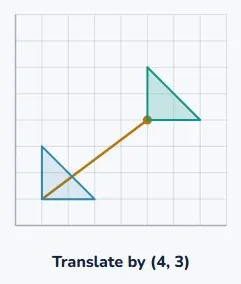
Translation: slide it
- Four squares across and three up.
- Every vertex moves by the same amount.
- Same lengths, same angles, same shape. Just elsewhere.
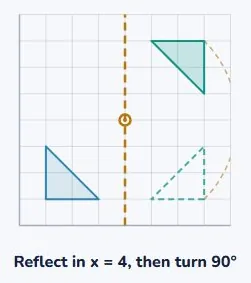
Reflection and rotation, one after the other
- First a flip in the line x equals 4.
- Then a quarter turn about the point (4, 4).
- Two moves, and the shape is still exactly the size it started.
Try it: the four moves
That is what congruent means
- Identical in shape and size. Not similar. Identical.
- Slide, flip and turn can never break it.
- You could cut one out and lay it exactly on the other.
Now the fourth move
- Pick a point to work from. Call it the centre.
- Measure from the centre to a corner, and multiply.
- Do that to every corner with the same number.
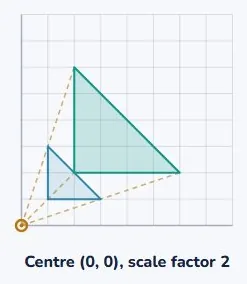
Enlargement by a scale factor of 2
- The centre is the corner of the grid, and it never moves.
- Every corner slides out along its own line, twice as far.
- Count the sides: every one has exactly doubled.
Try it: enlarge by a scale factor
Geometry board
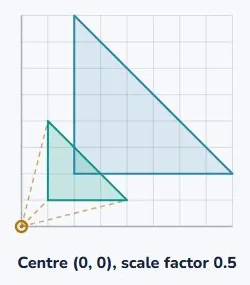
A scale factor of a half is also an enlargement
- Same move, same rays, same centre.
- The factor is 0.5, so every distance halves.
- It gets smaller, and it is still called an enlargement.
And that is what similar means
- The angles did not change. They never do.
- Every side changed by the same factor.
- Similar does not mean alike. It means an enlargement of.
| What you did | What it is called | What survived |
|---|---|---|
| Slide, flip, turn | congruent | sides and angles kept |
| Resize | similar | angles kept, sides scaled |
| Congruent means | identical in shape and size | |
| Similar means | an enlargement of |
Using it to find a side you were not given
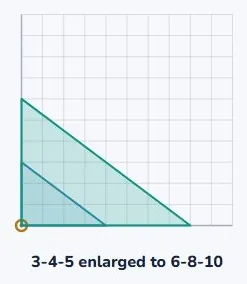
- A three, four, five triangle, enlarged.
- You are told one pair: the 4 became an 8. So the factor is 2.
- Every other side follows. Six and ten. Count them.
Try it: name the move
The reason anyone bothers
- A stick 1.5 metres tall casts a shadow 2 metres long.
- A tree beside it casts 14 metres. Same sun, same angle.
- Scale factor 7. The tree is 10.5 metres, and nobody climbed it.
| Step | Working | Result |
|---|---|---|
| A stick 1.5 m tall | casts 2 m | |
| A tree nearby | casts 14 m | |
| Same sun, same angle | so the triangles are similar | |
| Scale factor | 14 ÷ 2 | 7 |
| The tree is | 1.5 × 7 | 10.5 m |
Second half, and it is a different idea
- Nets are in the same unit as transformations and are unrelated.
- The honest link is that both flatten a shape into the plane.
- One by moving it about, one by unfolding it.
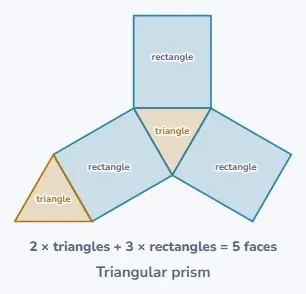
A net is the solid, opened out
- A triangular prism: two triangles and three rectangles.
- Five faces, and the net has to have all five.
- Cut it out, fold every edge, and it closes up.
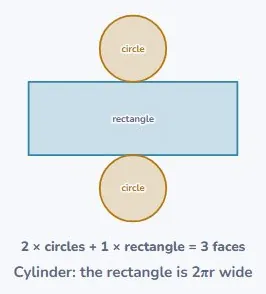
A cylinder, and the one fact worth keeping
- Two circles for the ends, one rectangle for the curved side.
- Unroll that side and it really is a rectangle.
- Its width is how far round the circle goes. The circumference.
What to take away
- Six things, and the third one is the definition to keep.
| Slide, flip, turn | keep the size: congruent |
| Resize | keeps the angles: similar |
| Similar means | an enlargement of |
| Scale factor | is one known pair, divided |
| A factor under 1 | is still an enlargement |
| A cylinder net | rectangle width is the circumference |
Common mistakes
- The 5 became 15, so add 10 to every side: 5, 12, 13 becomes 15, 22, 23.Similar shapes scale by multiplying: the factor is 15 ÷ 5 = 3, so the sides are 15, 36 and 39.
- An enlargement by 2 doubles the angles too.Enlargement never changes an angle; only the side lengths are multiplied by the scale factor.
- A scale factor of 0.5 makes it smaller, so it is not an enlargement.It is still called an enlargement; a scale factor between 0 and 1 just makes every distance smaller.
- The curved side of a cylinder net is a rectangle as wide as the circle's diameter.It wraps all the way round the circle, so its width is the circumference, 2πr.
Your turn: eight questions
- Work all eight.
- Question 2 wants the factor first, then the other two sides.
- Question 3 is the tree again, with different numbers.
Scale factor 3 on a 2 cm side. How long?
Sides 5-12-13. The 5 becomes 15. SF?
A 2 m pole casts 3 m, a tree casts 12 m.
How many parts in a cylinder net?
A shape is moved four different ways. Which image is not congruent to the original shape?
A shape is enlarged by a scale factor of 0.5 and one side of the image is 7 cm. How long was that side on the original shape?
Triangle P has sides 4 cm, 6 cm and 8 cm. Which of these triangles is similar to triangle P?
A cylinder has radius 5 cm and height 12 cm. In its net, how long is the rectangle edge that wraps round a circle, to 1 d.p.?
Show answer
1. 6 cm, from 2 × 3. 2. The scale factor is 3, from 15 ÷ 5, so the other two sides become 36 and 39. Note the triangle is still right-angled: enlarging never changes an angle. 3. The scale factor is 4, from 12 ÷ 3, so the tree is 2 × 4 = 8 m. The pole and the tree make similar right-angled triangles because the sun is at the same angle to both. 4. Three: two circles for the ends and one rectangle for the curved side. The rectangle is as wide as the circles are round, which is 2 × π × r. 5. The enlargement by a scale factor of 3. Slide, flip and turn keep the size, but an enlargement changes every side, so the image is similar, not congruent. 6. 14 cm. A factor of 0.5 halves every length, so the original side was 7 ÷ 0.5 = 14 cm. 7. 6, 9 and 12 cm. Every side is 1.5 times the original (6 ÷ 4, 9 ÷ 6 and 12 ÷ 8 all give 1.5), so it is an enlargement of P. 8. 31.4 cm. That edge wraps once round the circle, so it is the circumference: 2 × π × 5 = 31.4 cm to 1 d.p.
The answers
- Two times three is six centimetres.
- Factor 3, so the other sides are 36 and 39.
- Factor 4, so the tree is 8 metres.
- Three parts: two circles and a rectangle.
| Answer | |
|---|---|
| 1 | 6 cm |
| 2 | SF 3, then 36 and 39 |
| 3 | SF 4, so 8 m |
| 4 | Three |
Challenge
A triangle has corners P(2, 1), Q(5, 1) and R(2, 5). It is reflected in the line x = 4, then that image is reflected in the line x = 7. Find the final corners, and show that the two reflections together are the same as one single translation. Which translation?
Hint
Reflecting in x = 4 sends a point to the same distance on the other side: x becomes 8 − x. What does reflecting in x = 7 do? Then combine them.
Answer
Final corners (8, 1), (11, 1) and (8, 5): a translation of 6 units to the right
Step by step
- Reflecting in x = 4 keeps y the same and sends x to 8 − x. So P, Q, R go to (6, 1), (3, 1) and (6, 5).
- Reflecting in x = 7 sends x to 14 − x. So those go to (8, 1), (11, 1) and (8, 5).
- Compare with the start: every point moved 6 to the right and 0 up.
- In general x becomes 14 − (8 − x) = x + 6 for every point, so it is always a translation of 6 right.
- The 6 is twice the gap between the two mirror lines (7 − 4 = 3).
Full working
- x = 4: x → 8 − xsame distance on the other side of 4
- P(2, 1) → (6, 1), Q(5, 1) → (3, 1), R(2, 5) → (6, 5)first reflection
- x = 7: x → 14 − xsame distance on the other side of 7
- (6, 1) → (8, 1), (3, 1) → (11, 1), (6, 5) → (8, 5)second reflection
- 14 − (8 − x) = x + 6true for every point
- (8, 1), (11, 1), (8, 5): translation 6 right, 0 up
A street lamp is 4.8 m tall. Ana, who is 1.8 m tall, stands 6 m from the foot of the lamp. How long is her shadow, and how far is the tip of her shadow from the foot of the lamp?
Hint
Draw it. Ana and the lamp each make a right-angled triangle with the ground, and both triangles end at the tip of the shadow. Call the shadow s and write the ratios.
Answer
Her shadow is 3.6 m long, and the tip is 9.6 m from the lamp
Step by step
- The light ray from the top of the lamp just passes the top of Ana's head and hits the ground at the shadow tip.
- So the small triangle (Ana and her shadow s) and the big triangle (the lamp and 6 + s) are similar: same angles.
- Corresponding sides are in the same ratio: height ÷ base is equal, so 1.8s = 4.86 + s.
- Cross multiply: 1.8(6 + s) = 4.8s, so 10.8 + 1.8s = 4.8s, so 3s = 10.8 and s = 3.6.
- The tip is 6 + 3.6 = 9.6 m from the lamp. Check: 4.8 ÷ 1.8 and 9.6 ÷ 3.6 are both 83.
Full working
- 1.8s = 4.86 + ssimilar right-angled triangles share the tip
- 1.8(6 + s) = 4.8scross multiply
- 10.8 + 1.8s = 4.8s, so 10.8 = 3scollect s on one side
- s = 3.6divide by 3
- 6 + 3.6 = 9.6distance from the lamp to the tip
- Shadow 3.6 m; tip 9.6 m from the lamp
A closed cylindrical tin has a net whose rectangle is 10π cm wide and 8 cm tall. (a) Find the radius of the tin and the total area of the net, as an exact multiple of π. (b) A similar tin is made by an enlargement with scale factor 2. What is the total area of its net?
Hint
The rectangle's width is the circumference, 2πr. For part (b), every length in the net doubles. What happens to the area of one rectangle when both of its sides double?
Answer
(a) r = 5 cm, net area 130π cm² (about 408.4 cm²) (b) 520π cm² (about 1633.6 cm²)
Step by step
- The rectangle wraps round the circle, so its width is the circumference: 2πr = 10π, so r = 5 cm.
- Each circle has area π × 5² = 25π, so the two ends are 50π.
- The rectangle is 10π × 8 = 80π. The whole net is 50π + 80π = 130π cm².
- Scale factor 2: the radius becomes 10 and the height 16. Every length doubles.
- New net: two circles 2 × π × 10² = 200π, rectangle 20π × 16 = 320π, total 520π.
- 520π is 4 × 130π: doubling every length multiplies the area by 2 × 2 = 4.
Full working
- 2πr = 10π, so r = 5rectangle width is the circumference
- 2 × π × 5² = 50πthe two circular ends
- 10π × 8 = 80πthe curved side
- 50π + 80π = 130π ≈ 408.4 cm²the whole net
- 2 × π × 10² + 20π × 16 = 200π + 320π = 520πr = 10, height 16 after enlargement
- (a) r = 5 cm, 130π cm² (b) 520π cm² ≈ 1633.6 cm²
Practise this
Report a mistake
Is your child on track?
Take the free placement test