Objects and the materials they are made of
What this lesson covers
- An object is a thing; a material is what it is made of
- Wood, metal, plastic, glass, fabric and rock are common materials
- Some objects use one material and some join several together
- Words for how materials look and feel
- Using our senses to find out about a material
- Sorting materials into groups
Objects and materials
- An object is a thing you can see and touch, like a cup or a chair.
- A material is what the object is made of.
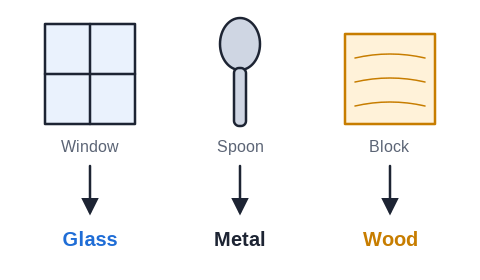
- A spoon can be made of metal. A toy block can be made of wood.
- Wood, metal, plastic, glass, fabric and rock are all materials.
One material or more than one
- Some objects are made of just one material. A glass marble is all glass.
- Other objects join different materials together.
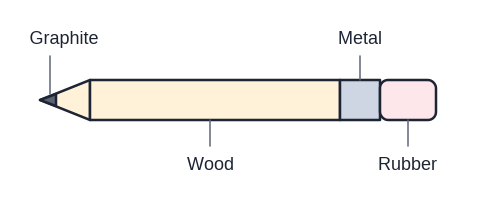
- A pencil has a wood outside and a grey middle called graphite. Some pencils also have a metal band and a rubber end.
- A school bag can have fabric, plastic clips and a metal zip.
Use your senses
- Your senses help you find out about a material.
- Look at it. What colour and shape is it?
- Touch it. Is it rough or smooth? Is it hard or soft?
- Bend it gently. Does it bend, or stay stiff?
- Tap it and listen. Wood makes a dull knock. Metal can ring.
- Never taste a material to test it.
Words for materials
- Scientists use clear words to say what a material is like.
- Something that bends without breaking is called flexible.
| Word | It means | Example |
|---|---|---|
| Smooth | No bumps | Glass |
| Rough | Bumpy | Rock, tree bark |
| Hard | Does not squash when you press it | Metal |
| Soft | Squashes when you press it | Wool, a sponge |
| Flexible | Bends without breaking | Rubber, fabric |
| Stiff | Does not bend | A wooden block |
Try it: bends or stays stiff?
Describing a material
- Mia holds a glass marble. What can she say about the glass?
- Look: it is round and you can see through iteyes
- Touch: it is smooth and hardhands
- Bend: it does not bend at allgentle hands
- Glass is smooth, hard and stiff
Try it: what is it made of?
Sorting into groups
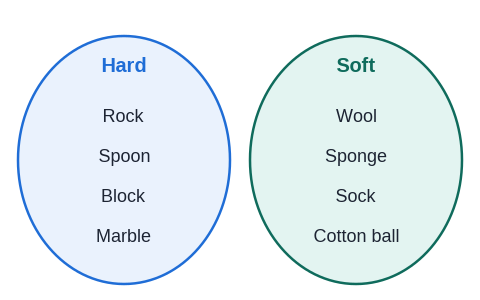
- Room 3 found 8 objects and sorted them by one thing: hard or soft.
- Hard: a rock, a metal spoon, a wooden block and a glass marble.
- Soft: wool, a sponge, a sock and a cotton ball.
- They could sort the same objects again another way, such as flexible or stiff.
Try it: hard or soft?
Common mistakes
- The object and the material are the same thing.The object is the thing, like a chair; the material is what it is made of, like wood.
- A clear plastic cup is made of glass because it looks the same.Some plastic looks like glass, but plastic is lighter and bends a little, while glass is stiff and can break.
- Every object is made of only one material.Many objects join materials, like a pencil made of wood and graphite.
A material hunt at home
You need: a metal spoon, a sock, a wooden peg or block, a plastic lid, a stone from the garden
- Put the five objects on a table.
- Feel each one. Say if it is smooth or rough, and hard or soft.
- Try to bend each one gently with your hands.
- Make two piles: the ones that bend, and the ones that stay stiff.
- Look for this: the sock bends, but the spoon, the peg and the stone stay stiff.
Safety: Ask an adult to help pick the objects, and leave out anything sharp, made of glass, or small enough to fit in your mouth.
Your turn
What material is a window made of?
A jersey is soft and flexible. Is it made of fabric or rock?
Which is harder: a metal spoon or a wool sock?
A pencil is made of wood and graphite. Is that one material or more than one?
A stone and a jersey. Which one bends?
Show answer
1. Glass. 2. Fabric. 3. The metal spoon. 4. More than one material. 5. The jersey bends; the stone stays stiff.
Recap
- An object is a thing. A material is what it is made of.
- Wood, metal, plastic, glass, fabric and rock are materials.
- Some objects use one material; some join several.
- We look, touch, bend and listen to find out what a material is like.
- We can sort materials into groups, like hard and soft.
Challenge
Ben's pencil has a wood outside, a grey graphite middle, a metal band and a rubber end. How many materials is it made of? If you cut off the metal band and the rubber end, how many are left?
Hint
Count each part that is made of something different.
Answer
4 materials. After cutting off the band and the end, 2 are left: wood and graphite.
Step by step
- Name each material: wood, graphite, metal and rubber.
- That is 4 different materials.
- Cutting off the band takes away the metal. Cutting off the end takes away the rubber.
- Wood and graphite are left, so 2 materials.
Full working
- wood, graphite, metal, rubberone material for each part
- 4 materialscount them
- 4 − 2 = 2take away metal and rubber
- 4 materials, then 2 left
Guess my material! I am hard. I am stiff. You cannot see through me. When you tap me, I ring. Am I wood, glass, metal or fabric?
Hint
Use one clue at a time to cross out a material.
Answer
Metal.
Step by step
- Fabric is soft and bends, so it is not fabric.
- You can see through glass, so it is not glass.
- Wood makes a dull knock when you tap it, so it is not wood.
- Metal is hard and stiff and can ring, so it is metal.
Full working
- hard and stiffnot fabric
- cannot see throughnot glass
- rings when tappednot wood
- Metal
Two clear cups look just the same. One is glass and one is plastic. You must not taste, drop or break them. How can you find out which one is glass? Give two ways.
Hint
Use your senses. Hold each one in your hand. Press each one gently. Tap each one.
Answer
Any two of these: the glass cup feels heavier; when you press gently, the plastic cup bends a little but the glass cup stays stiff; when you tap them, the glass cup rings or clinks and the plastic cup does not.
Step by step
- Looking does not help, because they look the same.
- Hold one in each hand. Plastic is lighter, so the heavier one is glass.
- Press each one gently. Plastic bends a little. Glass stays stiff.
- Tap each one gently and listen. Glass makes a clear clink.
Full working
- holdglass feels heavier
- press gentlyplastic bends a little, glass stays stiff
- tap and listenglass clinks
- Two of: heavier, stiffer, clinks when tapped
The maths behind it
Report a mistake
How is Year 1 maths going?
See the Year 1 maths guide