Living things: plants, animals and fungi
What this lesson covers
- Every living thing is called an organism
- The big groups: plants, animals, fungi and bacteria
- Plants such as grasses, ferns and trees
- Animal groups: fish, amphibians, reptiles, birds, insects and mammals
- Why fungi are not plants, and why we never touch them
- Doing a survey and showing what we found
What is an organism?
- A living thing is called an organism.
- Organisms grow, need food and water, and make more of their own kind.
- A tūī is an organism. So is a pōhutukawa tree.
- A rock is not alive. It does not grow or eat.
Big groups of living things
- There are many kinds of organisms.
- Four big groups are plants, animals, fungi and bacteria.
- Bacteria are so tiny that you need a microscope to see them.
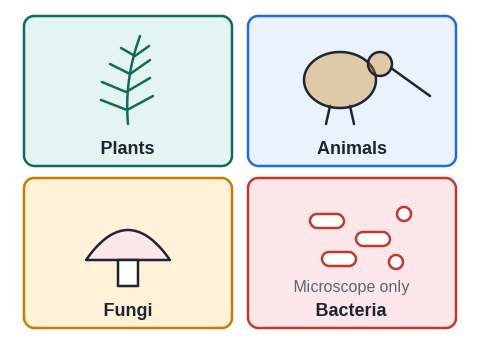
Plants come in many shapes
- Grasses are thin and grow close to the ground.
- Ferns have long leaves called fronds. A new frond is curled up, and this curl is called a koru.
- Trees are tall, with a hard woody trunk, like a kauri.
- Most plants are green.
Groups of animals
- Animals can be put into groups by what their bodies are like.
| Group | Look for | New Zealand example |
|---|---|---|
| Fish | Fins and scales, lives in water | Snapper |
| Amphibians | Smooth, damp skin | A native frog |
| Reptiles | Dry, scaly skin | Tuatara, gecko |
| Birds | Feathers and a beak | Kiwi, tūī |
| Insects | Six legs | Wētā, bee |
| Mammals | Hair or fur, babies drink milk | Native bat, people |
Try it: which animal group?
Fungi are not plants
- Mushrooms and toadstools are fungi.
- Fungi are not green, and they cannot make food from sunlight like plants do.
- They feed on dead leaves and old wood, and help break them down.
- Many fungi are poisonous. Never touch or eat a mushroom you find outside.
Try it: alive, and which group?
Which group?
- Put each one in a group: a kererū, a wētā, a mushroom and a fern.
- Kererū: feathers and a beak, so a birdlook for feathers
- Wētā: six legs, so an insectcount the legs
- Mushroom: not green, grows on dead wood, so a fungusnot a plant
- Fern: green fronds, so a plantgreen leaves
- Bird, insect, fungus, plant
Try it: plant, animal or fungus?
A survey in the school garden
- Room 4 looked for living things in their school garden for 10 minutes.
- They made a tally, then a picture graph.
- You can also find out about living things from books, a school journal, or pūrākau (traditional Māori stories) shared by your whānau.
| Living thing | Tally | Total |
|---|---|---|
| Snails | |||| | 4 |
| Worms | ||| | 3 |
| Birds | || | 2 |
| Bees | |||| | | 5 |
| Mushrooms | | | 1 |
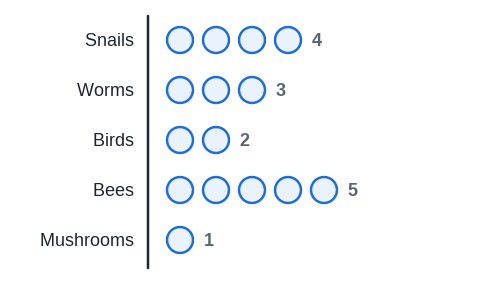
Try it: turn the tally into a graph
Drawing what you see
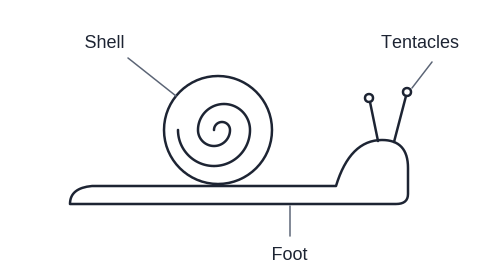
- A science drawing uses clear lines and no colouring in.
- Draw it big, and draw only what you can see.
- Add labels, with a straight line from each word to its part.
Common mistakes
- A mushroom is a plant because it grows in the ground.A mushroom is a fungus; it is not green and cannot make its own food from sunlight.
- A bat is a bird because it flies.A bat has fur and feeds its babies milk, so it is a mammal.
- A frog is a reptile.A frog has smooth, damp skin, so it is an amphibian; reptiles like geckos have dry, scaly skin.
A living things survey
You need: paper, a pencil, a clock or timer, a garden, park or school field
- Go outside with an adult and choose a small patch to look at.
- Look carefully for 10 minutes: on the ground, on plants and in the air.
- Make a tally mark each time you see a living thing.
- Count the tallies and draw a picture graph.
- Look for this: which living thing did you see most? Which group is it in?
Safety: Go with an adult, look but do not touch mushrooms, spiders, bees or wasps, and wash your hands when you come inside.
Your turn
Is a rock an organism?
A wētā has six legs. Which group is it in?
Which group is a mushroom in?
In Room 4's survey, which living thing did they see most?
A native bat has fur and feeds its babies milk. Which group is it in?
Show answer
1. No, because it is not alive. 2. Insects. 3. Fungi. 4. Bees, 5 of them. 5. Mammals.
Recap
- Every living thing is an organism.
- Plants, animals, fungi and bacteria are big groups of organisms.
- Plants include grasses, ferns and trees.
- Animals include fish, amphibians, reptiles, birds, insects and mammals.
- Mushrooms are fungi, not plants. Never touch them.
- A survey, a tally and a picture graph show what lives near you.
Challenge
Odd one out! A kiwi, a tūī, a native bat and a kererū. Which one is in a different group? Why?
Hint
Do not think about flying. Look at what each body has: feathers or fur?
Answer
The native bat. It has fur and feeds its babies milk, so it is a mammal. The other three have feathers and a beak, so they are birds.
Step by step
- Flying does not tell you the group. A kiwi cannot fly, but it is still a bird.
- A kiwi, a tūī and a kererū all have feathers and a beak. They are birds.
- A native bat has fur and feeds its babies milk. It is a mammal.
- So the bat is the odd one out.
Full working
- kiwi: feathers, beakbird
- tūī: feathers, beakbird
- kererū: feathers, beakbird
- native bat: fur, milk for babiesmammal
- The odd one out is the native bat
Room 5 made a tally of the living things in their garden. Snails: 4. Worms: 3. Birds: 2. Mushrooms: 1. Sam says, "We saw 10 animals." Is Sam right?
Hint
Is every living thing on the list an animal? Think about which group a mushroom is in.
Answer
No. They saw 10 living things, but only 9 animals. A mushroom is a fungus, not an animal.
Step by step
- Snails, worms and birds are animals.
- Add them: 4 and 3 and 2 make 9.
- A mushroom is a fungus. It is not an animal and not a plant.
- So there were 10 living things, but only 9 of them were animals.
Full working
- snails 4, worms 3, birds 2these are animals
- 4 + 3 + 2 = 9count the animals
- mushrooms 1a fungus, not an animal
- 9 + 1 = 10all the living things
- No: 9 animals, and 10 living things
In the bush there is one bird and some wētā. Altogether they have 14 legs. How many wētā are there?
Hint
A bird has 2 legs. A wētā is an insect, so it has 6 legs. Take away the bird's legs first.
Answer
2 wētā.
Step by step
- A bird has 2 legs.
- Take the bird's legs away: 14 take away 2 leaves 12 legs.
- A wētā is an insect, and insects have 6 legs.
- 6 and 6 make 12, so there are 2 wētā.
Full working
- bird: 2 legsbirds stand on 2 legs
- 14 − 2 = 12legs left for the wētā
- 1 wētā = 6 legsinsects have six legs
- 6 + 6 = 12two wētā
- 2 wētā
The maths behind it
Report a mistake
How is Year 1 maths going?
See the Year 1 maths guide